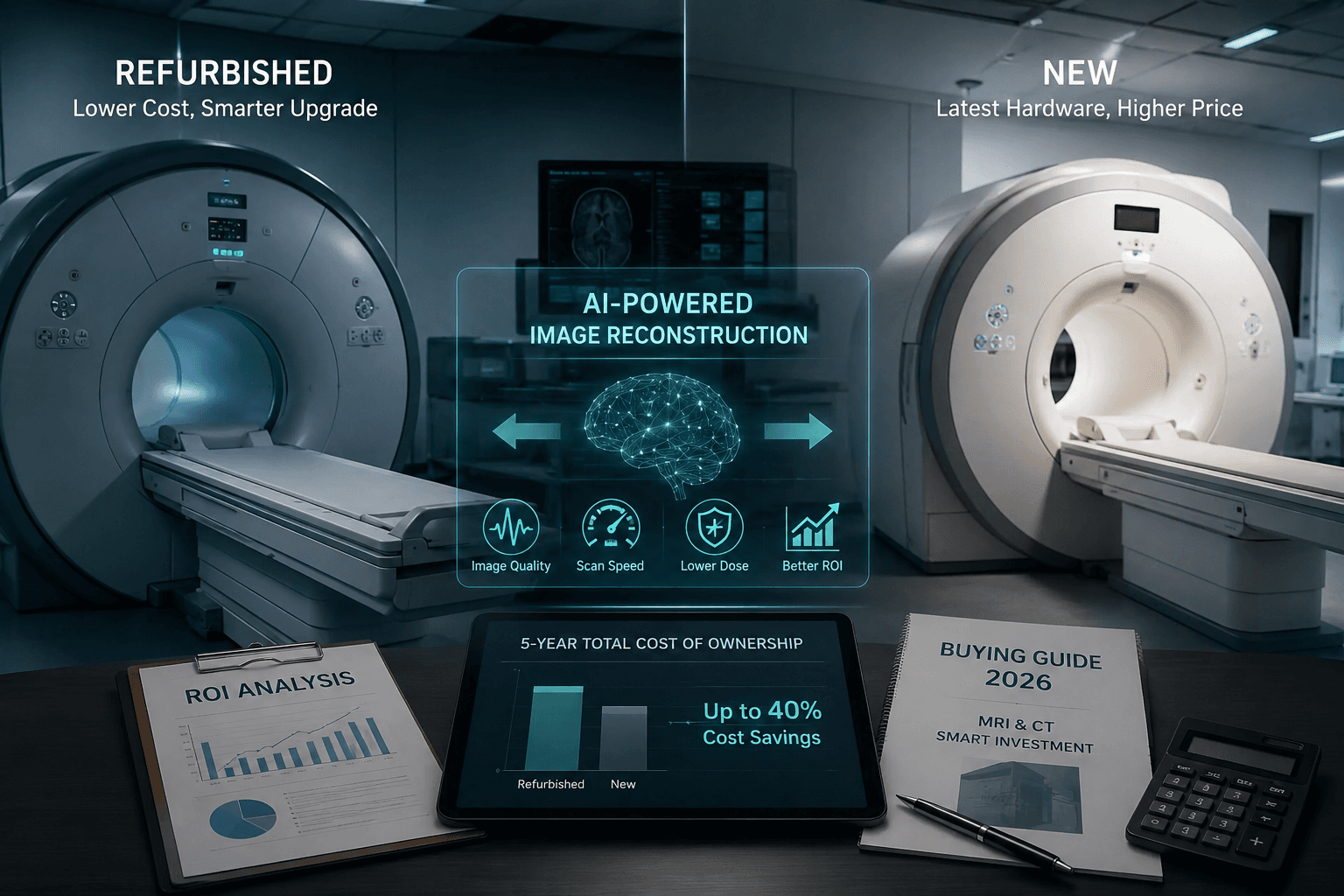
For a decade, better imaging meant one thing: buy newer hardware — a stronger magnet, more detector rows, faster gradient coils. For hospitals and imaging centers squeezed by reimbursement pressure, that answer keeps getting more expensive. AI image reconstruction has finally added a second option: old hardware plus new software, at a price that actually pencils out.
The Real Price Gap: Refurbished vs New MRI and CT
A new 1.5T superconducting MRI carries a list price of roughly $1.0 million to $1.5 million; a new 64-slice CT runs $400,000 to $700,000. For a secondary hospital or an independent diagnostic testing facility (IDTF), that capital expenditure (CapEx) starts a multi-year payback clock the moment it clears the loading dock.
A high-quality refurbished system, by industry estimate, cuts upfront CapEx by an average of 40% to 60%1. The gap, by modality:
Watch out: every number above comes from refurbishers' and trade media's public listings. It is an industry estimate — not an OEM list price, and not a guaranteed transaction price. Actual pricing moves with the unit's year, configuration, software version, and remaining useful life. Treat this table as an order-of-magnitude reference, not a quote.
What a Real Refurbishment Actually Involves
Plenty of buyers hear "refurbished" and picture a used machine with a fresh coat of paint. That conflates two different things: refurbished and used.
A genuine refurbishment is not a wipe-down. A standards-compliant refurbished MRI or CT passes through an industrial-grade quality-control process before it goes back on the market2:
- Full teardown and diagnosis — the core system is opened and tested component by component.
- Mandatory replacement of high-wear parts — the CT X-ray tube, the MRI cold head, and the helium system are swapped out regardless of apparent condition.
- Software reload and upgrade — the operating system and imaging software are reinstalled to a currently supported version.
- Phantom verification — image quality is pushed to its limit against standard phantoms.
- Full-load electrical safety testing — the system runs under full load to confirm electrical safety.
Expert insight: the fastest way to tell a real refurbishment from a repackaged used unit is to ask two questions — is there a traceable QC record, and is there proof the high-wear components (tube, cold head) were actually replaced? If a seller can't produce both, a low price is a warning, not a bargain.
The Three Tiers of the Used MRI Market
The used MRI market has sorted itself into three tiers, and three specs do most of the sorting: RF channel count, bore size, and software version3.
If you're a budget-constrained secondary hospital, Level 2 (16 channels) is usually the sweet spot — the most widely stocked, easiest to maintain, and best balance of price to performance. Level 3's 70cm bore mainly buys you comfort for claustrophobic or larger patients, at a meaningful price jump.
If you're narrowing down MRI tiers, you can compare used and refurbished MRI listings on MedTrade side by side — channel count, bore, and asking price — and send an inquiry directly to suppliers.
How AI Image Reconstruction Closes the Hardware Gap
The old hardware complaint is real: a 1.5T MRI from five to seven years ago has slower gradient coils and a noisier RF receive chain, which means longer per-sequence scan times and a throughput ceiling.
Deep learning reconstruction (DLR) changes that calculus. DLR operates directly in the raw data domain — MRI's k-space, CT's projection domain — and reconstructs clean, high-resolution images from undersampled, noisy acquisitions. The practical upshot: without touching the hardware, an old machine's image quality can approach that of a new one, while scan time compresses sharply. Vendor and review data claim specific sequences can be cut by up to 60% — from a traditional 4–6 minutes to under 3 — though these figures are vendor-claimed and should be read as such4.
For the technical mechanism — how DLR actually works in CT and MRI, and how the four OEM engines (GE, Siemens, Canon, Philips) differ — we broke it down in a separate deep dive: deep learning image reconstruction in CT and MRI.
Expert insight: "software-defined hardware" means you are no longer buying a machine — you're buying a hardware-plus-software-plus-service combination. When software can compensate for a hardware shortfall, the absolute age of the hardware stops being the only variable that matters.
The ROI Math: New vs. "Refurbished + AI"
Here's the arithmetic, as a worked example. It's a model meant to show the logic of "refurbished + AI" — not a financial promise to you.
Take a growing imaging center choosing between two build-out options:
- Option A: buy a new mainstream 1.5T MRI outright — about $1.2M.
- Option B: buy a quality refurbished 16-channel 1.5T MRI ($400K) plus a top-tier AI reconstruction engine, purchased or subscribed ($100K) — total CapEx roughly $500K.
At $300 per MRI exam and 300 operating days a year, the throughput gain alone adds roughly $900,000 in annual revenue in this model. Combined with the $700,000 in upfront CapEx saved, the system reaches capital recovery in roughly 8–10 months.
Watch out: the "30 patients a day," the "$900K a year," and the "8–10 month payback" are all assumed numbers from refurbishers' marketing models — the same "vendor internal modeling" trap we warned about in our clinical reality check on AI medical imaging. Real throughput depends on case mix, technologist staffing, reimbursement rates, and scheduling efficiency. Don't mistake a marketing model for a financial plan.
The capital logic of diagnostic procurement is shifting more broadly, too — see what the Deloitte B2B2C diagnostics trend means for equipment buyers.
If you're doing this math, you can search refurbished CT and MRI equipment on MedTrade, compare real quotes and delivery timelines, and send an inquiry directly to suppliers.
The Hidden Costs and the Pre-Purchase Checklist
Most comparison articles stop at "refurbished is cheaper." What actually hurts buyers is the cost hiding behind the quote. Before you sign, walk this list:
- Delivery lead time — a new unit can take 3–6 months from order to ocean freight, rigging, and calibration; refurbished units are often in stock and deliverable in weeks — but only if the supplier genuinely holds inventory. Get it in the contract.
- Warranty terms — refurbished warranties vary wildly in scope, duration, and response time. Read what's covered and, more importantly, what isn't.
- Sustained parts availability — confirm the tube, coils, and boards for this exact model will still be obtainable for years, or post-production servicing becomes a money pit.
- Cross-border shipping, rigging, and electrical safety — an MRI's helium and superconducting magnet impose special transport and siting requirements. Rigging, site prep, and electrical acceptance are all hidden costs. Budget for them.
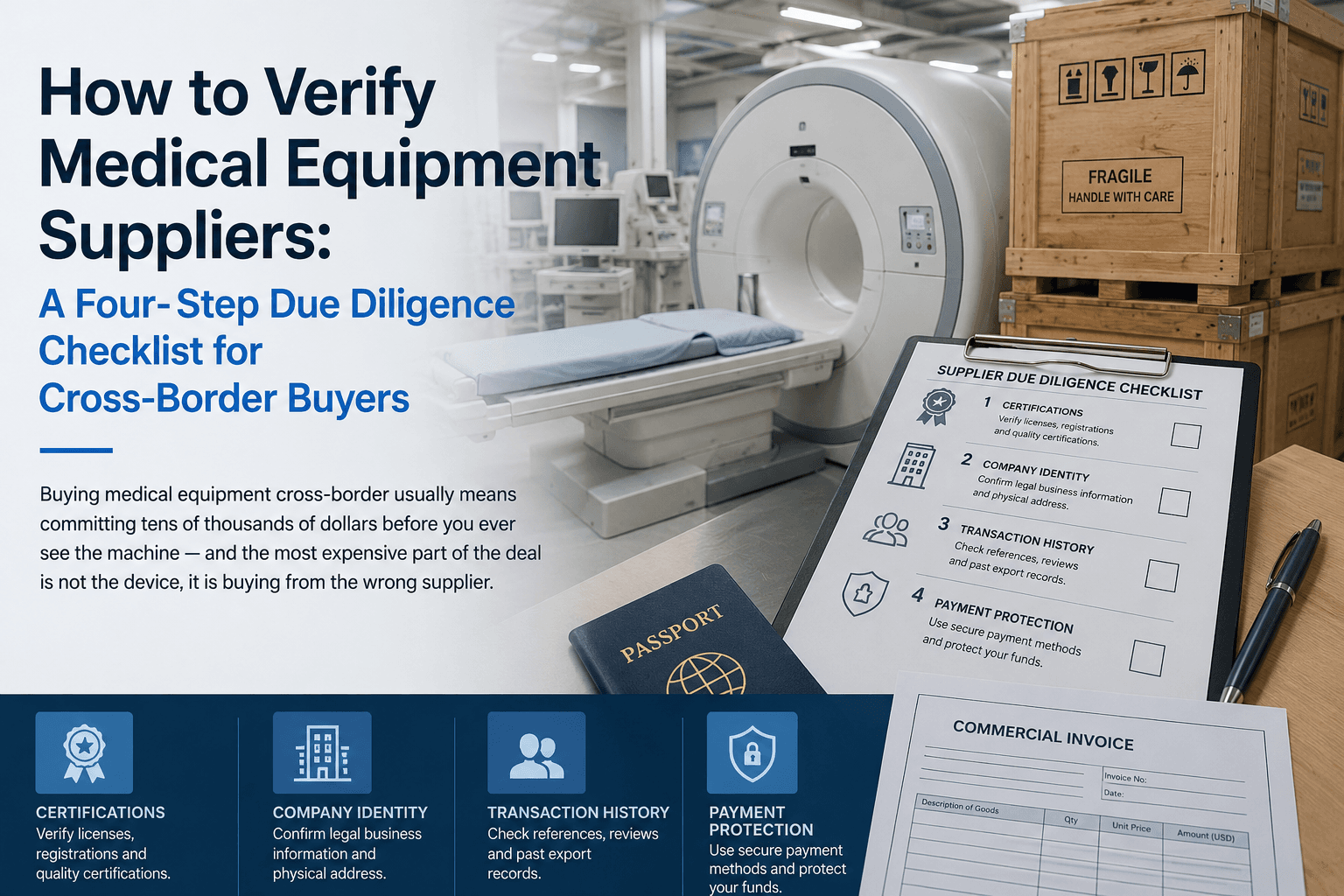
- Refurbished vs. used, again — confirm you're buying "refurbished" (with a QC process and replacement records) and not "used" (possibly just inspected and resold).
For the fuller new-vs-refurbished comparison method — the dimension-by-dimension version — see our ultrasound transducer buying guide.
The real value of a refurbished system isn't "cheaper." It's "the clinical capability you need, at a CapEx you can actually carry" — especially now that AI reconstruction has closed much of the hardware gap. Your job isn't to pick "new" or "old" on principle. It's to put configuration, software, warranty, and delivery timeline on the table and get competing quotes. Search used and refurbished MRI and CT equipment on MedTrade, compare configuration and delivery, and send an inquiry to suppliers — that's how you turn an industry estimate into your actual price.