Medical imaging has always been a two-step process: capture a signal, then reconstruct an image from it. For the last decade, the reconstruction step improved mainly by throwing hardware at it — stronger magnets, more detector rows, faster gradient coils. That era is ending.
Deep learning image reconstruction (DLR) flips the logic: instead of buying better physics, you buy better math. This article explains what DLR is, how the four major vendors approach it differently, and — most importantly for anyone signing a purchase order — which of the vendor numbers you can actually trust.
One boundary before we start. Reconstruction is the step from acquire to image. What happens after — an AI reading that image and proposing a diagnosis — is a separate problem, and one we've already examined skeptically in our clinical reality check on AI medical imaging. Conflating the two is the single most expensive mistake buyers make.
From Filtered Back Projection to Deep Learning: Why Legacy Iterative Reconstruction "Ruins" Images
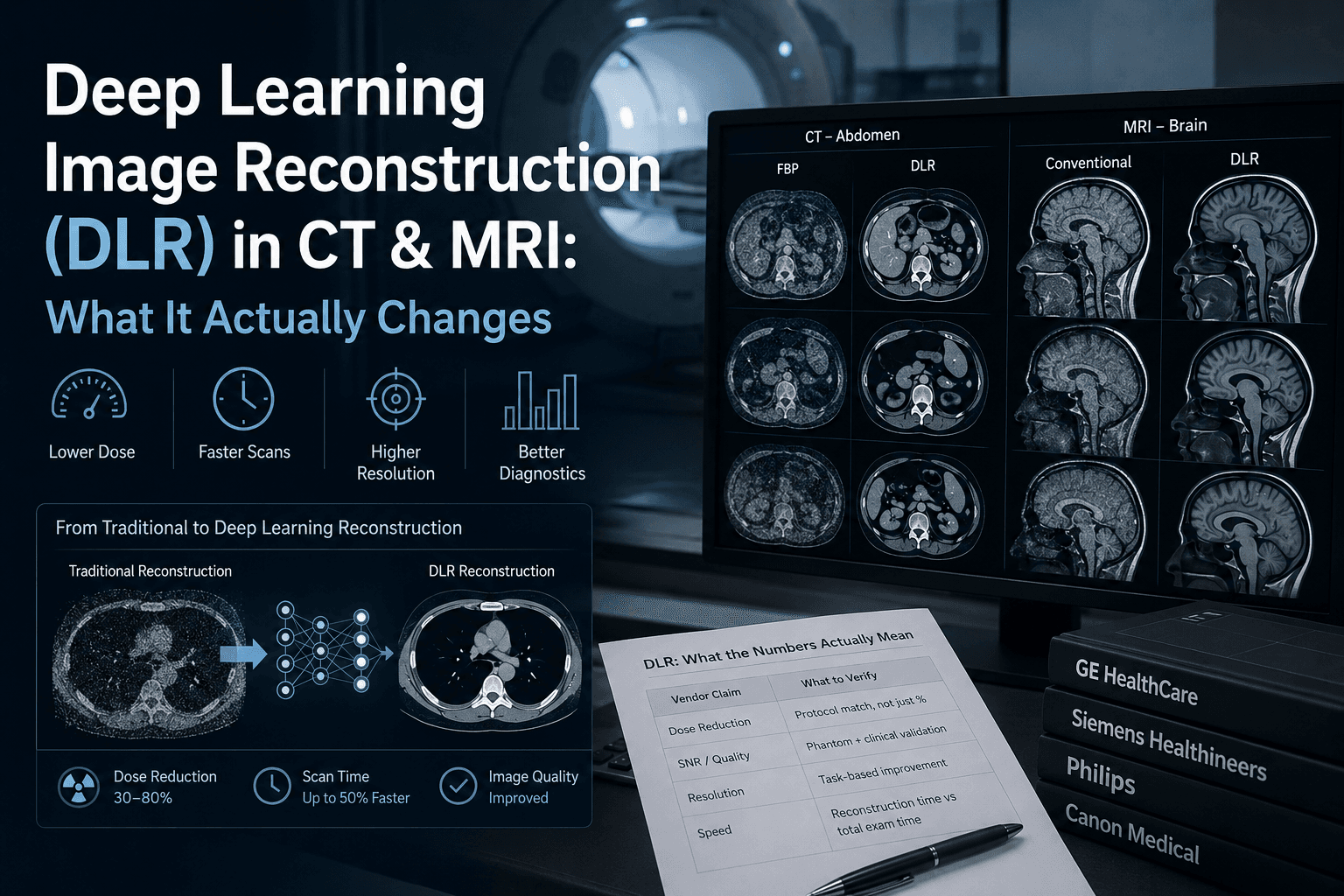
Three generations of reconstruction: FBP → IR → DLR
Image reconstruction has moved through three generations:
- Filtered back projection (FBP) — the original algorithm. Fast, but noisy, and demanding on raw signal quality.
- Iterative reconstruction (IR) — a statistical model that repeatedly guesses, corrects, and guesses again until it converges. For more than a decade, IR has dominated CT and MRI denoising and artifact suppression.
- Deep learning image reconstruction (DLR) — a neural network trained on tens of thousands of high-quality, fully sampled, high-SNR images, learning to "restore" an image directly from raw data.
These aren't simply "faster, better" versions of one another. FBP and IR are both statistical models; DLR is data-driven — a genuine methodological break.
The physical ceiling of iterative reconstruction: the "plastic" look at low dose
IR's problem is that its model is a guess. Iterative algorithms lean on complex statistical models and non-linear penalty functions. In extreme low-dose or high-acceleration scenarios, they suppress noise by smoothing the image flat — lesion edges and fine texture get wiped out along with the noise, leaving the unnatural "plastic" or "watercolor" look radiologists know well.
What does that mean in practice? When a clinician pushes dose down to the limit, IR returns an image that looks clean but has lost its detail. That's a physical ceiling, not a settings problem.
Why DLR is different: data-driven vs statistical
DLR skips the "guess the model" step entirely. It doesn't assume the image should follow some statistical distribution; it lets a network learn the restoration rule from real data. More importantly, DLR can reach back to the raw acquisition data itself — MRI's K-space (the raw data domain, a frequency domain rather than an image) or CT's projection domain — and reconstruct at the most "original" layer of the signal, rather than patching an image that has already lost information.
That's the core difference: IR touches up at the image level; DLR reconstructs at the data level.
The Four Vendor Engines, Side by Side
All four major OEMs ship a DLR engine, but the technical philosophy and clinical emphasis differ. One caveat up front: every performance number below is a vendor claim or a review-source figure — none of it is independently verified clinical data.
GE: AIR Recon DL / TrueFidelity
GE's AIR Recon DL (MRI) is the canonical "operate on raw K-space" approach. Traditional accelerated acquisition sacrifices some high-frequency data and fills the gap with zeros, which produces truncation artifacts — the ring-like false texture at image edges. AIR Recon DL drops that compromise: a deep network restores the high-frequency detail directly in K-space, removing truncation artifacts without loss. GE claims gradient-coil on-time drops by as much as 85% in neuro applications 1.
On the CT side, TrueFidelity emphasizes sharp reconstruction kernels (the mathematical filters that set the sharpness-versus-noise balance), optimized for visualizing fine structures in high-spatial-resolution work.
Siemens: Deep Resolve
Siemens' Deep Resolve is modular: "Deep Resolve Gain" handles systematic denoising, "Deep Resolve Sharp" pushes spatial resolution. The flagship is Deep Resolve Swift Brain, which pairs deep-learning acceleration with multishot echo-planar imaging (Multishot-EPI) — a fast MRI sequence — to deliver all standard brain contrasts (T2, T2*, Dark Fluid) in one pass. Siemens claims this compresses a full multi-contrast brain exam from 10–15 minutes to 3–4 minutes 2.
Canon: AiCE / PIQE
Canon's AiCE (Advanced Intelligent Clear-IQ Engine) is algorithmically distinctive. It uses a 7×7 discrete cosine transform (DCT) to split data into a zero-frequency component and 48 high-frequency components, cleans only the high-frequency noise through repeated 3×3 convolutions with soft-shrinkage, then losslessly recombines it with the untouched zero-frequency signal. Canon claims this frequency separation yields a 36%–70% reduction in CT radiation dose 3, with image quality at or above the far slower model-based iterative reconstruction (MBIR). The newer PIQE algorithm pushes super-resolution, aiming past the physical sampling limits of the detector hardware.
Philips: Precise Image / SmartSpeed AI
Philips pairs SmartSpeed AI on MRI — a deep-learning denoiser (Adaptive-CS-Net) fused with Compressed SENSE, the vendor's compressed-sensing technique — running serialized denoising and data-consistency cross-checks to separate real signal from background noise. On CT, Precise Image targets 80 kVp ultra-low-dose work: a phantom study showed its advanced sharpening preset (PI-Sharper) suppresses low-voltage noise while preserving fine-structure fidelity and edge sharpness 4.
The four engines at a glance
What DLR Actually Saves: The Real Ledger of Dose, Time, and SNR
DLR's pitch reduces to three numbers: radiation dose, scan time, and signal-to-noise ratio (SNR — the ratio of signal to noise; higher means a cleaner image). These three are also exactly where a buyer should apply the heaviest discount.
Dose: how much you save, and what it costs
CT dose is a hard metric. Canon's AiCE claims 36%–70% reduction 3 — a wide range, because the actual figure depends on anatomy, patient size, and protocol. Note what dose reduction costs: detail. When an algorithm suppresses noise, it can smooth away faint lesion signals along with it. "Low dose" is never "free"; it's a trade between radiation and detail.
Scan time: the truth behind 10–15 minutes to 3–4 minutes
Siemens' Swift Brain takes a full brain from 10–15 minutes to 3–4 minutes 2; GE's AIR Recon DL claims up to 85% less gradient on-time 1. The real value here is throughput — shorter scans mean more patients per day. But ask the obvious question: these figures are measured under optimal protocols on specific systems. In a real clinical environment, they rarely reproduce exactly.
SNR vs resolution: what's physical, and what's marketing
SNR gains are DLR's most "real" benefit, because they're physically measurable. Claims like "resolution improvement" or "detail preservation" tilt toward vendor language and deserve independent verification. A useful test: does the number have independent, non-vendor-funded validation? Canon compares AiCE against MBIR (Model-Based Iterative Reconstruction — the highest-quality but slowest reconstruction method) and claims parity or better 3, but "better than our own previous generation" is a weak benchmark.
Watch out: every performance number in this section comes from a vendor claim or a review source — none is the result of an independent, multi-center randomized controlled trial. Treat them as directional, not decisive.
If you're evaluating CT, the dose-percent marketing war matters less than comparing real configurations and lead times. You can compare CT scanners on MedTrade and send an inquiry directly.
DLR and Refurbished Equipment: Can Software "Rescue" Old Hardware?
Software-defined hardware: why an old scanner can approach new-image quality
For years, the thing that stopped institutions from buying older MRI/CT systems was a physical generation gap — 5-to-7-year-old hardware lags in gradient response speed and RF receive-chain SNR, dragging out scan times and capping throughput. DLR changes that equation: the hardware is old, the algorithm is new.
Without touching the underlying hardware, DLR can reconstruct the undersampled, noisy raw data from lower-field, lower-channel coils into images that visually approach new-system quality, while compressing acquisition time. That's "software-defined hardware" — the bottleneck in image quality is shifting from hardware to algorithm.
Now the reality check: this is not a universal rule. Whether an old system benefits from DLR depends on whether the OEM offers software support for that model, and whether any third-party AI engine holds the right regulatory clearance. Not every aging MRI can be "rescued by software." Treat these claims as industry estimates, not platform guarantees — whether a specific unit can be upgraded needs to be verified case by case.
The buying framework: new machine vs. used machine + AI upgrade
For a budget-constrained buyer, the real decision isn't "should I get DLR" — it's "do I spend on hardware, or on a hardware-plus-software combination." The full framework — real price gaps for refurbished systems, the QC process, the three-tier used market, and payback math — is a topic for its own dedicated buying guide. The one-line conclusion here: if your budget is fixed, converting some of the new-machine premium into AI software can beat piling on hardware — but only after line-by-line accounting, not on the strength of a slogan like "AI makes old machines new again."
Expert insight: the highest-ROI refurbished systems tend to be the ones whose OEM still ships current-generation reconstruction software for that exact platform. Before you price an AI upgrade, confirm the specific model's software roadmap — not the platform's general marketing line.
If you're weighing refurbished MRI options, you can compare MRI scanners on MedTrade by brand and lead time, and send an inquiry.
DLR's Limits and the Procurement Traps
Most competitor articles stop at "DLR is great." The parts that actually save you money are the three below.
Training-data bias: the cross-site, cross-population generalization risk
A DLR model is trained on specific scanners, specific populations, specific protocols. Move it to another hospital, another patient mix, another protocol, and performance can degrade — the same generalization gap we flagged in our reality check on AI medical imaging. When a vendor shows you demo images, they are almost always best-case results. Real-world generalization needs independent, cross-institutional validation.
"Reconstruction" ≠ "diagnosis": DLR is not diagnostic AI
This is the most common confusion — and the most common place a buyer trips over the line. DLR optimizes image quality (physics), not diagnostic conclusions (clinical practice). It reduces dose, shortens scans, raises SNR — but it does not, and should not, be marketed as "improving diagnostic accuracy" or "reducing missed diagnoses." Diagnostic accuracy is a matter of clinicians plus clinical validation, not reconstruction math. Any claim that repackages DLR's physical gains as "better clinical outcomes" should set off an alarm.
Vendor claim vs. independent verification: how to tell
Every headline number in this article — 85%, 3–4 minutes, 36%–70% — shares one trait: it's a vendor claim or a review figure, not an independently verified clinical result. When you're buying, ask one question about every number: "Is there a verification source independent of the vendor?" If not, treat it as directional, never decisive.
Bottom line. DLR is rewriting the competitive rules of CT and MRI — but it's rewriting the reconstruction step, not the diagnosis step. For a buyer, that means three things. First, the bottleneck in image quality is shifting from hardware to algorithm, so the value of older hardware needs reappraisal. Second, every performance number is a vendor claim — discount it. Third, reconstruction and diagnosis are different things; don't let the two be conflated in the sales pitch.
Whether you're buying new or refurbished, you can compare CT and MRI systems on MedTrade by configuration, brand, and lead time — and send an inquiry directly to suppliers.