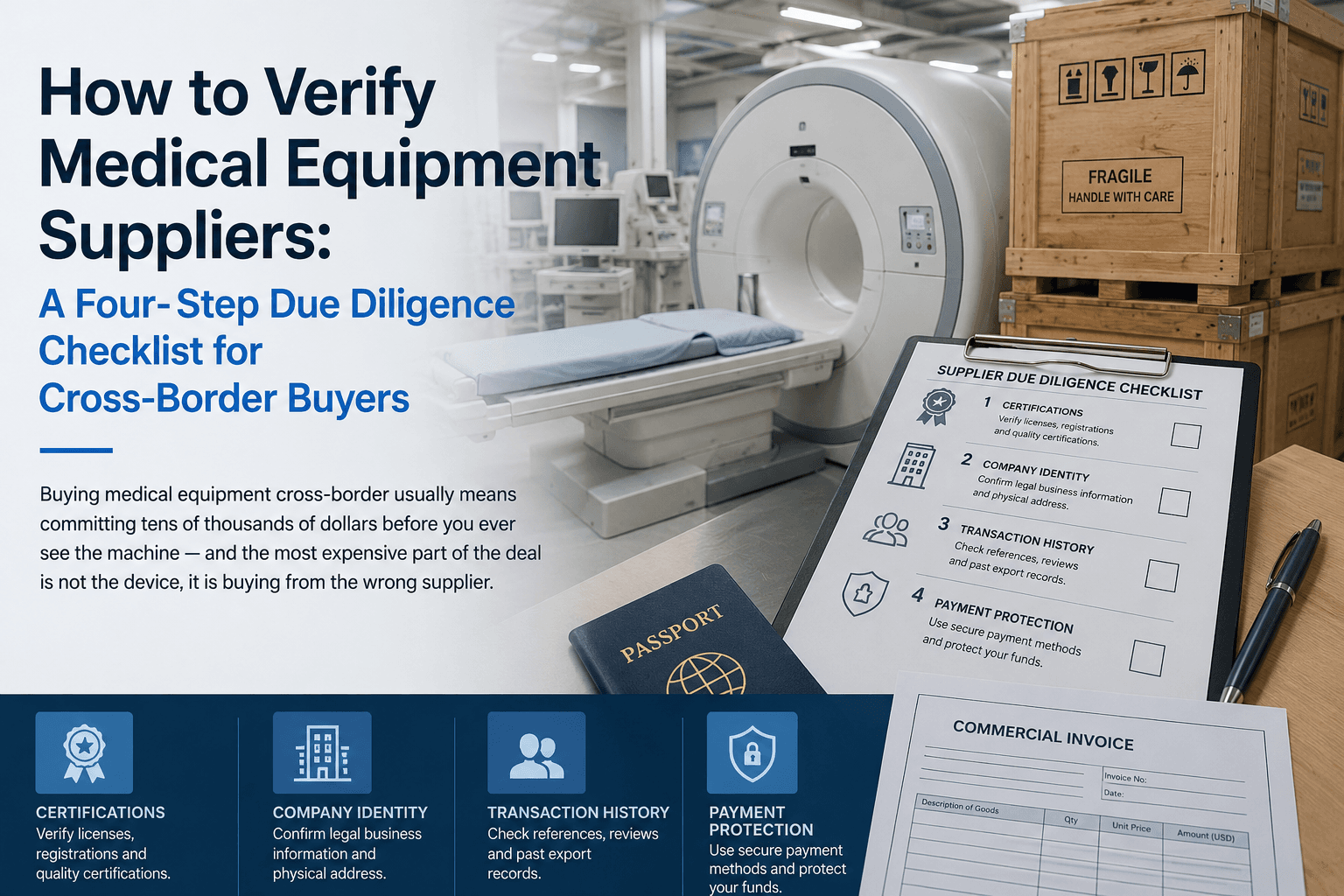
Buying medical equipment cross-border usually means committing tens of thousands of dollars before you ever see the machine — and the most expensive part of the deal is not the device, it is buying from the wrong supplier. Counterfeits, refurbished units sold as new, and suppliers who vanish after a deposit are real risks in this trade. This guide gives you a four-step checklist you can run today: certifications → company identity → transaction history → payment protection.
Why You Must Verify a Supplier Before a Cross-Border Medical Equipment Purchase
The Risk Profile: Fakes, "New" Refurbished Units, and Vanishing Deposits
Medical equipment is a low-frequency, high-value, highly specialized purchase. Because purchases are infrequent, buyers accumulate little experience; because the value is high, the payoff for fraud is large; and because the equipment is specialized, it is hard to judge at a glance. Three risks dominate:
- Counterfeit or imitation products — fake branded parts or systems that look right until they are installed
- Refurbished units sold as new — used or reconditioned systems passed off as brand-new at a premium
- Deposit fraud — a supplier takes a large prepayment and disappears, especially common in cross-border deals without escrow
The trust problem gets bigger as procurement moves onto platforms. When purchasing shifts from offline relationships to online marketplaces, how do you know who is on the other side of the screen? We discussed this platform-driven shift in our analysis of how diagnostics procurement is going B2B2C — it turns supplier verification from an option into a requirement.
The Cost of Verification vs. the Cost of Being Defrauded
Verification takes time — checking credentials, making calls, matching addresses — minutes to hours per item. Compare that with the cost of a bad deal: a six-figure deposit, a machine you cannot use, and the cascading downtime that follows. The time cost of verification is negligible by comparison. Treat verification as part of the procurement process, not an optional extra.
"Looks Trustworthy" Is Not Trustworthy
A polished website, a PDF certificate with a logo, an enthusiastic sales pitch — all of these cost little to fake. Paper certificates are especially unreliable: scans can be edited, logos can be borrowed. So the point is not whether a supplier "has certificates," but whether those certificates can be verified and whether the company identity checks out.
💡 Expert Insight: There is a simple asymmetry in procurement — a fraudster's cost is disguise, a buyer's cost is verification. Disguise can be nearly free (an edited PDF), while verification takes real effort. That cost asymmetry decides who stays in control.
Step 1: Read the Certifications — What ISO 13485, CE, FDA, and NMPA Each Prove
Four Certifications: What They Mean and Which Markets They Cover
Watch the boundaries: ISO 13485 proves a quality system; CE, FDA, and NMPA prove market access. They are different dimensions — do not treat them as the same thing.
How to Check a Certificate: Find the Number, Look It Up
Never trust a scanned certificate on its own. Two steps:
- Find the number — every compliant document carries a registration, certificate, or notified-body number
- Check the official database — FDA establishment registration, the EU Notified Body database, or the NMPA registry; it verifies only when the number exists and the company name matches
⚠️ Watch Out: Expiry dates are a trap. An expired FDA registration or ISO certificate looks like a credential but no longer is one. Always cross-check issue and expiry dates when verifying.
Certifications Prove Compliance, Not Quality
Even fully verified certifications only mean the company operates within the rules — they say nothing about the quality of a specific machine. Compliance is the floor, not the ceiling. That is why step two checks the company identity and step three checks transaction history.
Step 2: Check the Company — Registration, Age, Business Scope, Identity
Company Verification Checklist
Shell-Company Red Flags
Treat any of these as serious warnings when several appear together:
- Founded less than a year ago with minimal capital
- Company name and business scope mismatch (e.g., a trading firm selling "factory-new" systems)
- Pricing well below market average — too low to be credible
- Pressure to pay a deposit while refusing inspection or third-party testing
- A bank account in a third country or third party that does not match the contracting entity
Cross-Check the Paying Entity Against the Contracting Entity
The most common failure point in cross-border deals: the contract names one company and the bank account belongs to another. Before paying, confirm that the contracting entity, the invoice issuer, and the bank account holder are the same. A mismatch is a major red flag, no matter how reasonable the explanation.
Step 3: Check Transaction Trails and Repair History — Repair Reports, Deal Records, Reputation
Why Repair History Is a Verification Goldmine Unique to Medical Equipment
Medical equipment is not a consumer product — it carries a traceable repair history: what was fixed, what was replaced, before-and-after measurements. That record is closer to the machine's true condition than any sales pitch. When you are buying used or refurbished equipment, repair history is the key evidence of "what this machine has been through." If you need a framework for weighing refurbished against new, start with our refurbished vs. new ROI buying guide.
Repair Reports: Structured, Public Repair Records
On MedTrade, suppliers can create Repair Reports — structured records of brand, model, fault description, before-and-after measurements, and photos, published as public pages and searchable in the Report Plaza 3. For a buyer, that is a directly viewable, data-backed repair record: what was fixed and to what degree, at a glance. Searching the Report Plaza for repair records on the same equipment type is a concrete way to see whether a supplier actually services equipment and how well.
Cross-Verify Reputation and Deal Records
The third layer is triangulation: verify across multiple sources. Ask for deal records and client references, and independently search third-party reviews and forums. A single source can be polished; consistent signals across several sources are much harder to fake.
How to Run a Quick Verification on a Platform — Verified Badge, Supplier Profile, Report Plaza
The Verified Supplier Badge: A Human-Reviewed Trust Signal
MedTrade issues a Verified Supplier badge: suppliers upload certifications such as ISO 13485, CE, FDA registration, and NMPA, plus business licenses, and the platform's admins review them before a green shield is shown 4. The badge means "this supplier's credentials passed platform review" — a useful starting point, but it is not a transaction guarantee. Payment protection still sits with you.
What a Supplier Profile Shows
A verified supplier's profile displays company information, credential badges, product listings, service listings, and contact details. Focus on two things: whether the credentials are complete and whether the products match the description. Cross the profile against your company-verification checklist and you will screen out most problem suppliers.
A Three-Step Quick Due Diligence Flow
Compress the full process into a 10-minute version:
- Check the badge — does the supplier carry a Verified badge, and are credentials on the profile 4?
- Check the trail — search the Report Plaza for repair records on the same brand and look for anomalies
- Check the entity — take the profile's company name and match it to registration and the bank account
Browsing the MedTrade supplier directory with this flow will quickly narrow your shortlist.
The Deep Dive — When No One Guarantees the Deal: Designing Your Own Payment Protection and Evidence Trail
The Escrow Assumption Is Often Wrong
Many buyers assume "platform transaction" means "guaranteed." Most medical equipment B2B platforms do not mediate the deal, payment, or delivery between buyer and seller — MedTrade included. It provides inquiry, quoting, and verification tools; the deal and the payment happen off-platform 5. So do not treat a platform as an escrow agent. In fact, if a seller promises you "platform-guaranteed transactions," be extra suspicious.
Designing Your Payment Structure
Without a third-party escrow, your payment structure is your primary defense:
(These are common commercial practices, not legal rules — your specific terms live in your contract with the supplier.)
The Evidence Checklist
If something goes wrong, your ability to act depends on what you kept:
- Contract — model, configuration, new/used status, payment milestones, breach terms
- Communication — quotes, chats, emails, all retained
- Inspection evidence — inspection reports, photos, third-party testing after delivery
💡 Expert Insight: In cross-border procurement, "trust but verify" is not an attitude — it is a cost control. Putting conditions in writing and keeping evidence is not assuming the other side is dishonest; it is making sure you have standing if something goes wrong. Your evidence trail is the one partner in a cross-border deal that never disappears.