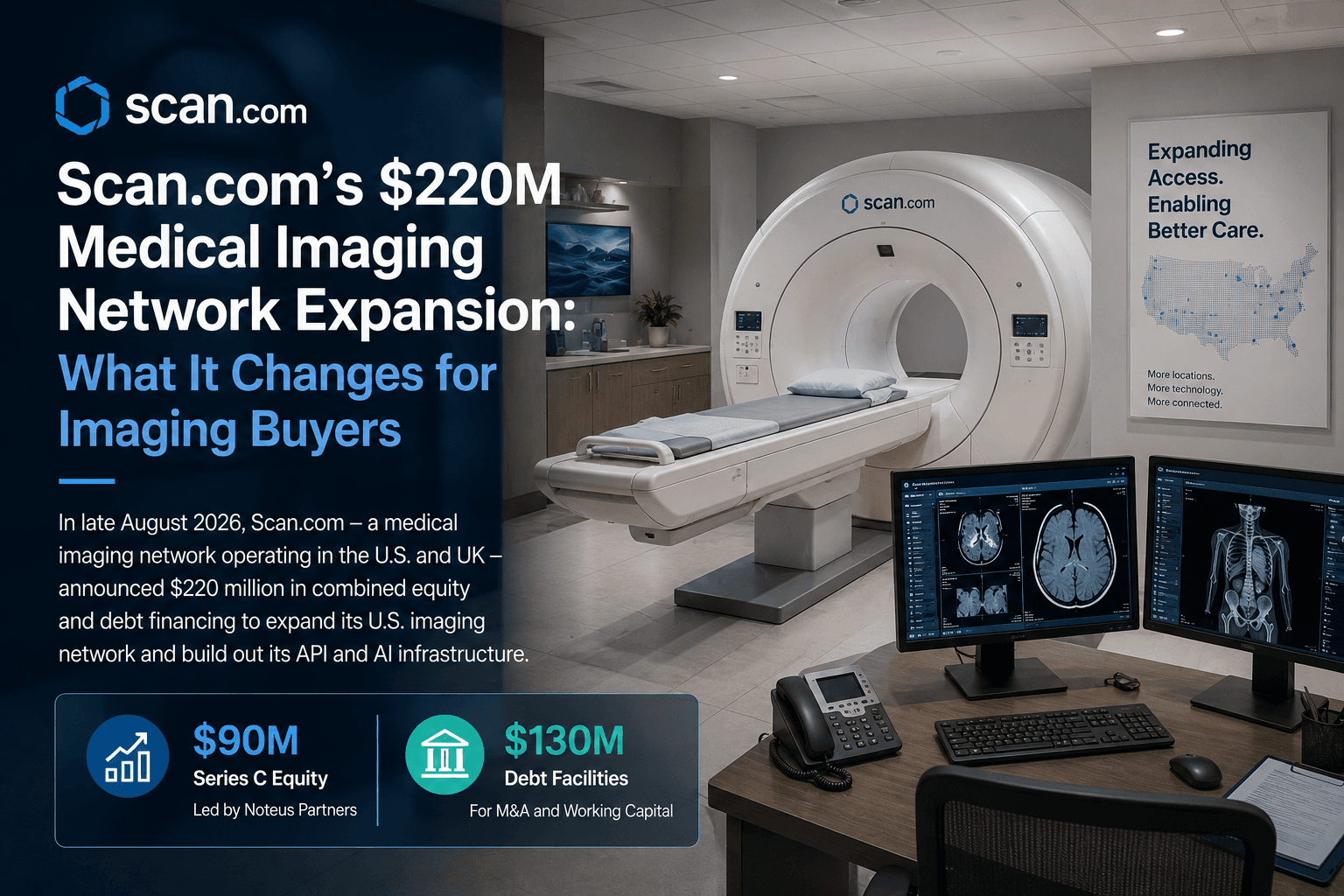
In late August 2026, Scan.com — a medical imaging network operating in the U.S. and UK — announced $220 million in combined equity and debt financing to expand its U.S. imaging network and build out its API and AI infrastructure 1. This is more than another imaging funding round; it is a signal that U.S. imaging is moving from fax-booked, opaque-priced fragmentation toward network consolidation. For anyone buying imaging equipment — whether you run an independent imaging center, a hospital radiology department, or a used-equipment reseller — the trend raises questions worth answering before you commit capital: where the money is going, how big the digitization gap really is, and what "joining a network" demands from your equipment.
Why $220 Million Is Going Into U.S. Medical Imaging — and Why the Market Is Still Underserved
The Deal Structure: $90M Equity + $130M Debt
The financing splits into two layers: a $90M Series C equity round led by Noteus Partners, with Aviva, Concord Health Partners, YZR Capital, and Oxford Capital participating; and $130M in debt facilities from VerisFi Capital and Atempo Growth, earmarked for M&A and working capital 1.
The split says something about the playbook: equity funds the model, debt funds the consolidation. That is how platform-style expansion is financed.
A $100B Market at "Under 1% Penetration"
The U.S. diagnostic imaging market is worth over $100 billion, projected to approach $121 billion by 2033, with roughly 600 million scans performed each year 2. Yet Scan.com's CEO puts the company's penetration at "under 1 percent" 3. A market this large with penetration this low is exactly what capital looks for: the direction has been proven, but the vast majority of the market still operates the way it did decades ago.
Growth in Numbers: $85M → $165M Run Rate, 900K+ Patients
Over the past year Scan.com doubled revenue to an annualized run rate above $165 million (from $85 million the year before) and has served 900,000+ patients globally 4. Before this round, the company had raised roughly $57 million since its 2021 seed 5. Even at $165 million, that is a rounding error against 600 million annual scans — which is precisely why the company talks about "decades" of room to run.
💡 Expert Insight: Three signals tell you a market is about to be digitized and consolidated: total size is large, operating efficiency is low, and players are fragmented. U.S. imaging has all three — a $100B+ market, 85% of bookings still done by fax, and a leading network at under 1% penetration. Capital keeps coming back to setups like this.
The 85% Fax Problem — How Big the Digitization Gap Really Is
"No National Infrastructure"
The CEO put the industry's problem in one sentence: the U.S. runs 600 million scans a year "with still no national infrastructure behind them" 3. At the operational level: roughly 85% of scan bookings still happen by fax or phone 3. Imaging centers, hospitals, employers, and insurers — every step between them still communicates the way it did thirty years ago.
What a Network Platform Actually Does: One API, Live Scheduling, Automated Routing
Scan.com's model can be summarized as a middle layer: a single national API that connects independent imaging centers' scheduling systems and electronic medical records; AI that matches referrals to the right center based on live availability, transparent pricing, and clinical subspecialty; automated booking and paperwork; DICOM files routed to subspecialized radiologists; and results typically returned within 48 hours 4. It is a connect-and-match platform — it does not operate scanners itself, it wires fragmented capacity into a network.
What This Means for Equipment Sellers and Service Providers
The value of a network platform is aggregated demand. Once an imaging center joins the network, it gains a stable source of bookings. Diagnostic procurement is shifting from one-to-one relationships toward platform connectivity — a shift we examined in our analysis of how diagnostics is going B2B2C: when purchasing decisions move from inside the hospital to a platform layer, equipment vendors face a set of integration standards rather than a single department.
The Same MRI Can Cost 10x More Down the Street — What Price Opacity Means for Buyers
Where the Price Gap Comes From: Fragmented Negotiation, No Public Benchmarks
In the same city, the same MRI exam can cost a few hundred dollars at one center and several thousand at another 3. This is not an anomaly; it is the direct result of an industry with no centralized pricing infrastructure, where every exam is negotiated independently and there are almost no comparable public price anchors.
Exam Price and Device Price Are Two Different Games
For buyers, there is an easy point of confusion: the price of an exam and the price of the device are separate.
Exam prices are becoming more transparent as platforms publish them; device prices only become transparent when you have multiple vendors' quotes side by side.
How Buyers Can Use Transparent Comparison to Control Cost
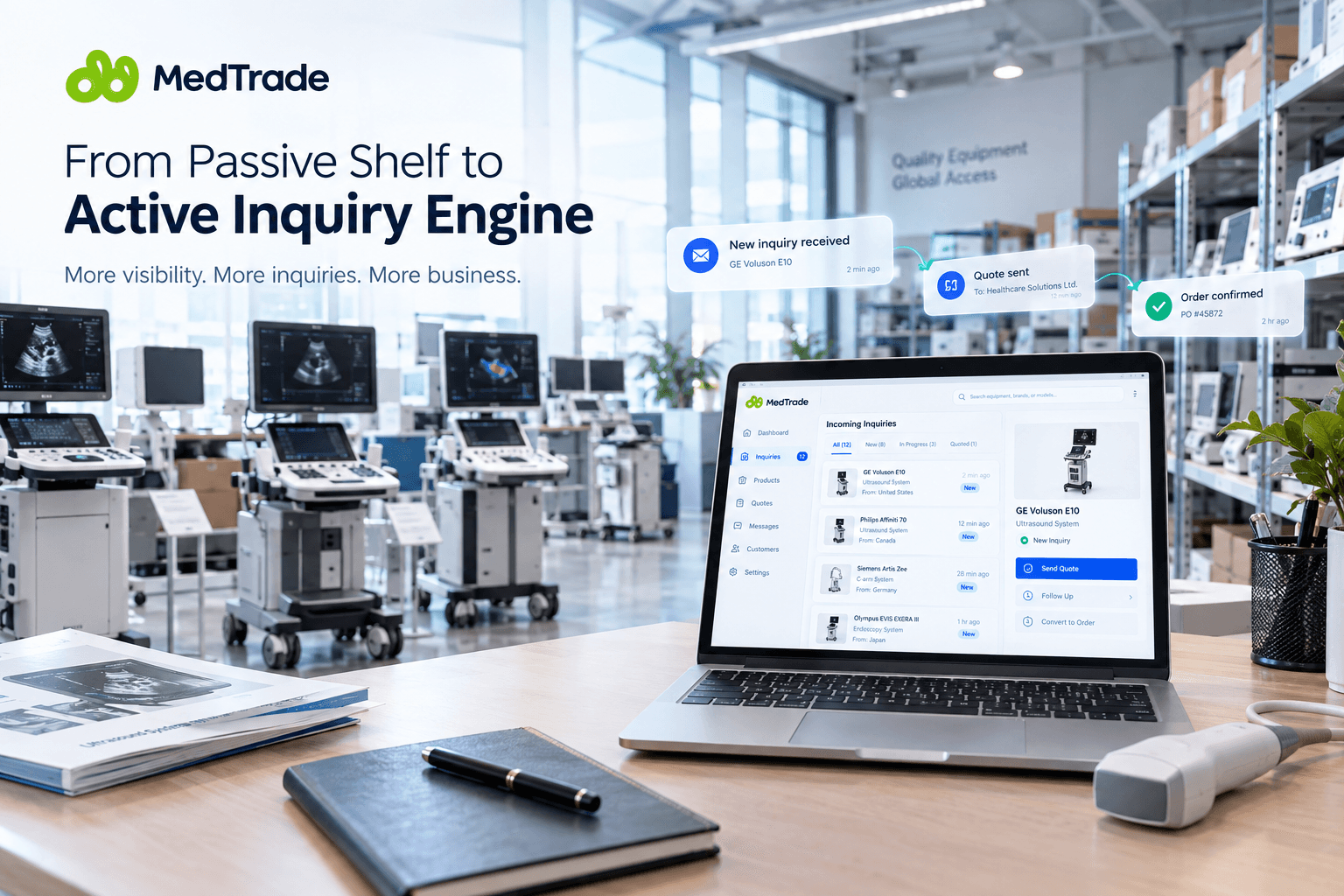
As exam prices get squeezed, imaging centers look to cut costs — and equipment procurement is one of the largest controllable line items. Whether you are standing up a new imaging center or upgrading an existing department, comparing MRI and other imaging quotes across suppliers is the fastest way to control cost. Search MRI equipment and send inquiries on MedTrade to compare multiple vendors' quotes and credentials on one screen.
How Imaging Network Consolidation Affects Equipment Procurement
Network Growth Means More Equipment Purchases
Networks expand by acquiring and building. Every imaging center folded into a network triggers upgrades, capacity expansion, and backup-system demand. For equipment sellers and used-equipment dealers that is real incremental volume — but it is a structural observation, not a prediction of who wins. We deliberately do not call winners here.
Interoperability Becomes a Hard Requirement: DICOM/PACS
The hidden demand of networked imaging is interoperability: can a device send images into a PACS using the DICOM standard, and can it integrate with the network's scheduling and EMR systems? That decides whether the device can "join the network" at all. A scanner that cannot connect is an expensive paperweight.
The Used/Refurbished Angle (Stated, Not Predicted)
Consolidation is an opportunity for refurbished-equipment dealers too — but only if the refurbished unit meets the same interoperability and reliability bar. Imaging refurbishment is a mature market; DICOM/PACS connectivity and guaranteed uptime are the two gates a refurbished scanner must clear to be network-ready.
What an Imaging Center Actually Buys — CT, MRI, Ultrasound
Platform Supply: What Is Out There
Imaging center procurement revolves around three categories: CT, MRI, and ultrasound. On MedTrade, all three are available for inquiry with the major brands represented:
New vs. Refurbished: Run It Through an ROI Framework
When budgets are tight, refurbishment is the default question. For high-value systems like MRI and CT, the price gap, maintenance costs, and usable lifespan between new and refurbished differ a lot. Our refurbished vs. new ROI buying guide lays out the full comparison framework you can apply directly.
Downtime and Service Contracts
When an imaging system goes down, it takes scanning capacity with it. Service contracts, parts availability, and response times — the "after-purchase" costs — often exceed the system price itself. We covered the downtime and maintenance trap in our analysis of predictive maintenance and downtime economics.
⚠️ Watch Out: There is a darker side to networked imaging: your equipment can become "locked into the network." Once your center joins, real-time availability, interoperability compliance, and service response stop being internal concerns and become contractual obligations. Treat "can this system join the network" as a first-class technical requirement — not something to discover after you have paid.
The Deep Dive — "Network Readiness": The Hidden Requirement Buyers Underestimate
An Interoperability Checklist
If your center might join an imaging network, run every prospective purchase through this checklist before signing anything:
Service and Parts: What Network Membership Demands of Reliability
Once you are in a network, your equipment's availability becomes a commitment to the platform and to patients. Service stops being "someone will fix it eventually" and becomes "how long until it is back online" — translated directly into breach risk. Put service terms (response times, parts lists, upgrade paths) and interoperability on the same priority level as price.
A "Network Readiness" Assessment Before You Buy
If you are planning any imaging equipment purchase — networked or not — "network readiness" belongs in the evaluation: can the system output standard DICOM, can it talk to PACS, does the vendor offer local service. Put the shortlisted vendors side by side and check interoperability and service capability line by line before committing. Search MRI equipment and send inquiries on MedTrade — comparing vendors' credentials, interface capability, and service terms on one screen gets you closer to the real cost than negotiating one supplier alone.