The equipment manager's worst fear isn't an expensive machine — it's a stopped one. An MRI that goes down costs far more than most people calculate. Here's the bill, and what predictive maintenance actually changes about it.
What Unplanned Downtime Actually Costs
The cost of unplanned downtime is never just the price of a replacement part. It's a chain reaction that keeps compounding the longer the machine sits idle.
What One Down Day on an MRI Adds Up To
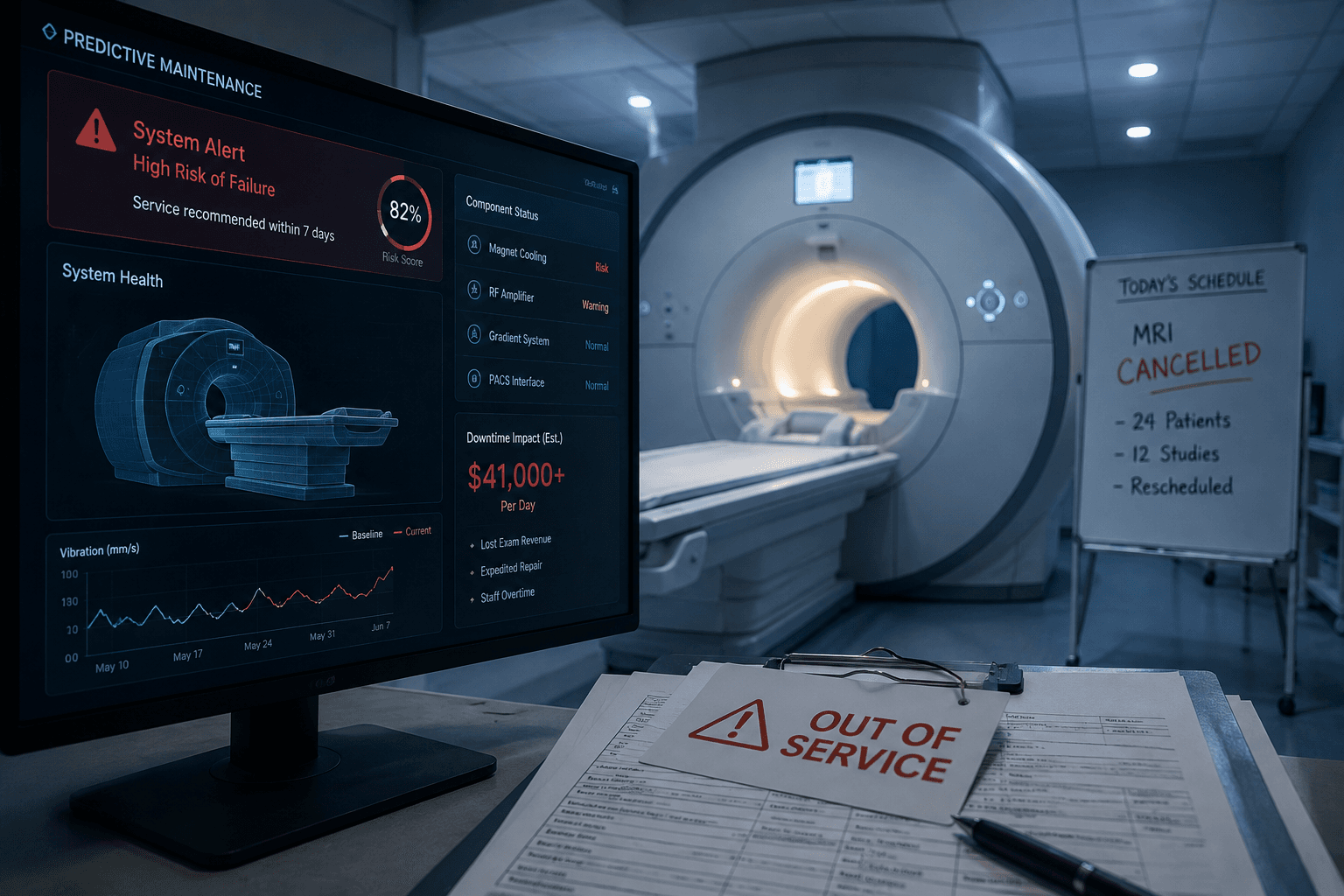
According to industry estimates from large imaging centers and busy hospitals, a single day of MRI downtime can exceed $41,000 in direct and indirect cost.1 That figure bundles three things:
- Lost exam revenue — dozens of patient appointments cancelled or pushed out;
- Expedited repair — rush freight and parts premiums;
- Staff overtime — technologist schedules thrown off, hours reworked.
⚠️ Watch Out: That $41,000 figure is an industry estimate, not an audited number. But the direction is clear — downtime costs far more than the part itself.
The Hidden Loss on PET/CT, and the Cumulative Price Tag
For molecular imaging that depends on short-half-life tracers, downtime is even more brutal: a system down for a day means ordered FDG (fluorodeoxyglucose) decays past its usable window, a loss above $15,000.1 Zoom out across the US health system, and the average cumulative cost of a single equipment downtime event is estimated at $740,000.2
💡 Expert Insight: Treat downtime as an operating incident, not a repair event. The meter keeps running in cancelled appointments, decaying tracers, and overtime — every hour the machine is dark.
The Technology Under the Hood — Digital Twins and IoT Telemetry
If downtime is this expensive, the reactive "fix it when it breaks" model stops looking acceptable. Predictive maintenance exists to turn a sudden failure into a forecastable one.
What a Digital Twin Is
The underlying mechanism is the digital twin. Hundreds of IoT sensors inside the equipment continuously stream telemetry from the gantry, cooling loop, imaging chain, and power modules — temperature swings, voltage drift, RF impedance, abnormal vibration. That data flows to the cloud, where an algorithm builds a living virtual model of each physical machine.
Using Fleet History to Predict Part Lifespan
The AI keeps comparing a machine's real-time baseline against failure history from tens of thousands of same-model units worldwide. The result is an early read on the remaining useful life (RUL) of high-value components — the X-ray tube, cold head, detector array — and their trajectory toward failure.
In plain terms: predictive maintenance doesn't react after a machine dies; it warns before it's about to. It converts an uncontrollable random failure into a controllable planned replacement.
From Reactive Repair to Proactive Intervention — the Numbers
The mechanism is one thing; the clinical engineering team wants the other thing — how much does it actually save?
OEM-Claimed Figures on Downtime and Tube Failure
A caveat first: the numbers below are OEM-claimed figures, not independent third-party verification. Keep that distinction when you quote them.
- GE reports its OnWatch Predict platform cuts MRI unplanned downtime by over 60% and CT by 58%.3
- Over a six-month AI activation window, it recovered roughly 28 hours per MRI and 36 hours per CT of scan time.3
- Its Tube Watch system, focused on X-ray tubes, cut tube-failure downtime by 89%.2
Smart Dispatch and Prepositioned Replacement
Predictive maintenance also generates smart dispatch — routing preventive part swaps to off-peak, overnight, or weekend windows so the clinic isn't disrupted. Industry data pegs the reduction in emergency service calls at 35%.1
💡 Expert Insight: Reactive repair is firefighting; proactive intervention is a physical. The difference is whether you find out about a failing part from a sensor or from a patient whose scan got cancelled. If you're trying to decide whether a piece of equipment needs attention now, a practical starting point is knowing how a failing component shows up — our ultrasound transducer failure diagnosis guide walks through exactly that for one common component.
How the Business Model Is Shifting — EaaS and Prepositioned Parts
Predictive maintenance isn't only an engineering advance. It's changing how hospitals pay for equipment at all.
From Selling Hardware to Equipment-as-a-Service
Historically, a hospital bought a machine and carried the maintenance risk alone. With AI's predictive accuracy, OEMs are now confident enough to sell contracts with a ~99% uptime guarantee — the essence of EaaS (Equipment-as-a-Service) and Uptime-as-a-Service.
The price tag is an annual service contract. Industry pricing guides put GE systems around $66,000–$134,000 per year and Siemens around $69,000–$113,000.4 Compared with reactive emergency repair after a failure, AI-driven early intervention is estimated to cost less than 40% of the reactive route.2
Prepositioned Parts and Faster Refurbished Turnaround
The supply chain shifts too. AI can predict replacement points weeks or months out, letting expensive parts — CT tubes, MRI helium compressors — ship via routine freight instead of air-express to a local warehouse ahead of need, freeing cash trapped in inventory. Refurbishers use the same data to trace a retired machine's true health, pinpoint what must be replaced, and shorten the turnaround from teardown to resale.
A verifiable maintenance record beats a verbal promise — that's the operational lesson underneath all of this. On MedTrade, suppliers publish structured, signed Repair Reports you can look up before you trust a service claim: browse the Repair Report plaza.
The Real Barriers — Why Every Machine Isn't on Predictive Maintenance
The value is on the table. So are the barriers — otherwise this reads as an OEM brochure.
IoT Infrastructure and HIPAA Compliance
Standing up predictive maintenance means upfront investment in IoT sensors and edge-computing gateways. And the data — raw machine logs plus patient scheduling patterns — runs straight into privacy compliance (HIPAA in the US).
The Habit Change in Clinical Engineering
The harder wall is human. A clinical engineering team that has spent years in a "call when it breaks" routine has to learn to trust an AI alert and reshuffle schedules before anything fails. That's an organizational change, not a software install.
The Evidence-Grade Caveat
Most numbers in this article — downtime costs, reduction percentages, contract prices — come from OEM figures or industry estimates, a mixed and often low evidence grade. Treat them as "vendor claims" until you see independent data. Our reality check on AI medical imaging unpacks the evidence-grade problem in more depth.
The bottom line: predictive maintenance is real, but it has prerequisites — IoT infrastructure, data compliance, and an organizational habit change. For clinical engineering and equipment managers, the practical first step isn't a full AI prediction platform; it's building a verifiable maintenance record for the fleet you already run.
When you're making a maintenance or procurement decision, a record you can check beats a claim you can't. Suppliers on MedTrade publish structured Repair Reports — browse the Repair Report plaza. And if you're evaluating imaging equipment, you can search and send inquiries directly to suppliers for MRI systems and CT scanners.