Used ultrasound prices are the anchor most buyers never get: the figure a comparable unit actually asks on a live market this week, published by the seller rather than by a price guide. This article supplies that anchor from MedTrade's own inventory, and it arrives with a finding that changes how you should read it.
As of November 2026 the platform carries about 2,400 ultrasound probe listings and about 1,000 complete-system listings1. Only about one listing in five publishes an asking price at all2. The rest are quoted on enquiry, so the visible part of the market is the part that chose to advertise — and every figure below is an asking price, what the seller wrote down, never a transaction price.
What this benchmark measures — and what it does not
We took every live listing in the platform's two ultrasound categories, read the price each one publishes, and removed the entries that would have corrupted the distribution. Three rules did the removing, published here so you can disagree with them and re-run the arithmetic yourself.
Placeholder prices. A few listings carried a price below one dollar — $0, $0.03 — which is an unfilled form field rather than an offer3.
Consoles filed as probes. Dozens of entries in the probe category name a complete system, scanner or console and no transducer at all. Their prices, some of them five figures, belong to another product class. Removed rather than reclassified, because beyond the title we cannot verify what they are4.
Monitors and parts filed as systems. Dozens of entries in the system category are patient monitors, telemetry units, SpO2 modules, replacement boards, chargers or therapy units. They inflate the count and depress the median5.
Where a listing publishes a range instead of a single figure, we used the lower bound, and brand names were normalised on obvious aliases: GE and GE Healthcare are one brand, Acuson folds into Siemens, Toshiba into Canon, ATL and Hewlett Packard into Philips, Aloka into Hitachi, Zonare into Mindray, Medison into Samsung6.
One limit belongs up front: this is a snapshot taken in November 2026. The platform's listing count grows every week, so the relative structure of these ranges is the durable part, and any absolute count is a moment in time.
The probe market: what priced listings actually ask
Asking prices for ultrasound transducers, November 2026 snapshot7.
The shape of that table is the whole story. Half of the priced probes on the platform ask less than $1,650. A quarter ask less than $945, and a quarter ask more than $2,600. Nine in ten ask less than $3,600.
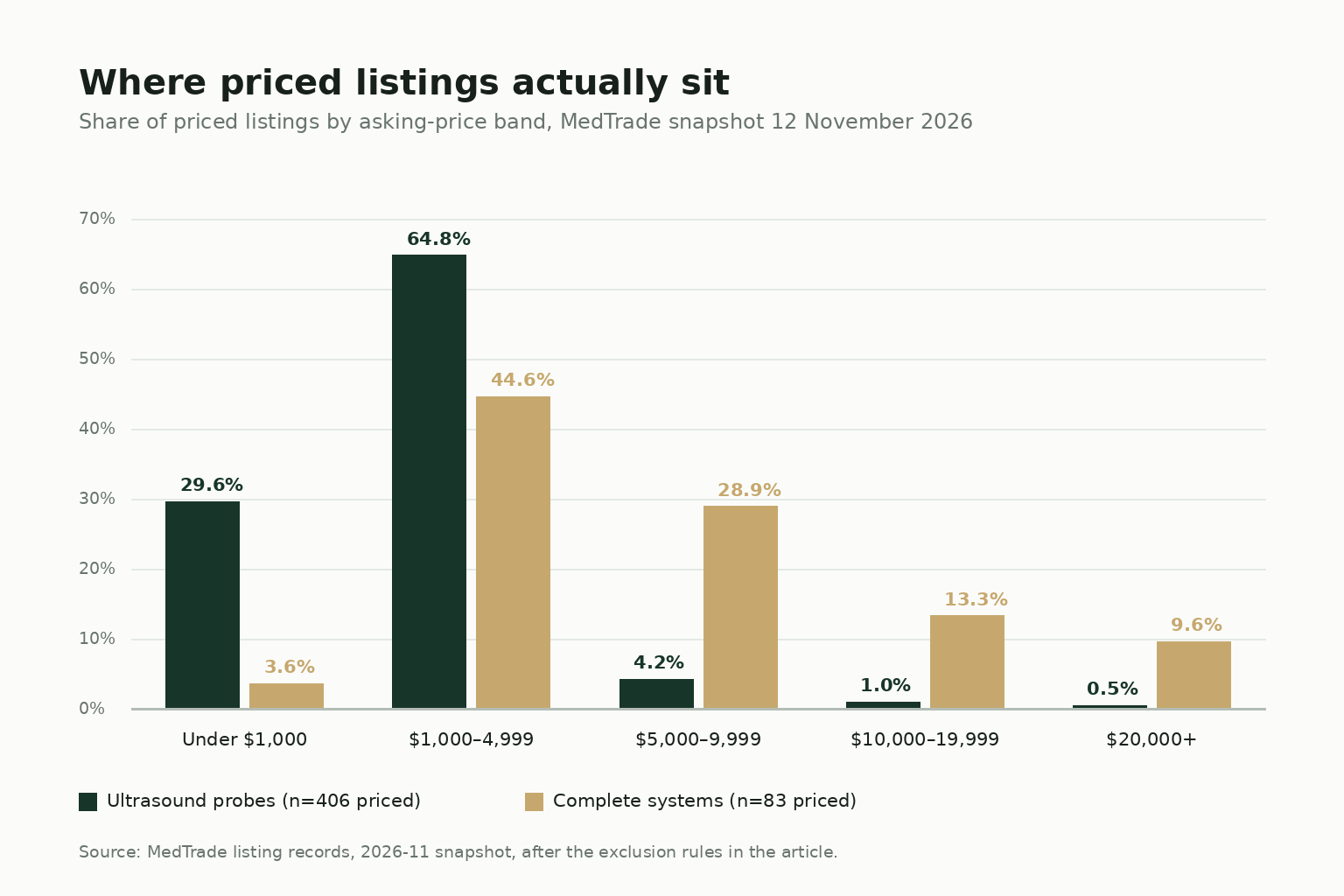
About three in ten priced probes ask under $1,000 and about two-thirds ask between $1,000 and $4,999, so roughly 94% of the priced probe market sits below $5,0008. What lives above $10,000 is a specific thing: transesophageal arrays, 4D volume arrays, and a few rare high-frequency parts. When a seller asks five figures for a single array, the price is describing a scarce product class, not a better probe.
The far end needs a warning. Two vector-array cardiac probes ask $30,250 and $31,250, roughly twice any other cardiac ask and consistent with new list price rather than a used-market ask. We kept them, but the P99 of $14,425 is the more useful ceiling to negotiate against9.
The system market: a wider spread on a thinner sample
Asking prices for complete ultrasound systems, November 2026 snapshot10.
Half of the priced complete systems ask less than $5,225. The middle half runs from $3,650 to $9,488, and the top decile starts at $19,880 — premium carts from the current generation.
The system market is far more evenly spread than the probe market: probes concentrate below $5,000, while systems distribute across four bands of roughly ten to forty per cent. Its sample is also much thinner, because complete systems publish a price far less often, so read these percentiles as indicative11.
Same category, very different money
Brand rows in the same table diverge far more than most buyers expect. All figures are asking prices. The count column is how many priced listings stand behind each row at the snapshot; it is the basis for trusting a row, not a measure of market size.
Probe asking prices by brand family, brands with at least five priced listings12.
Read the top and bottom rows: Hitachi's median is $790 and Esaote's is $2,500, a threefold gap inside one category. That is not a brand-quality ranking but a generation ranking: an array built for a scanner platform that left service years ago has a market made up of exactly the people still running that platform, and there are few of them.
Complete systems behave the same way, on a thinner sample:
System asking prices by brand family13.
Condition is marked by the seller — confirm it in the enquiry
Condition is a field the seller fills in when the listing is published, and only a minority of listings carry a mark at all. That is why this article does not split prices by new, used or refurbished: the labels are too sparse to build a comparable range on, and a sparse label is worse than no label, because it invites you to read a band the data cannot support14.
What that means in practice is simple. Condition, and how hard a unit has been worked, are things you establish in the enquiry rather than things you read off the listing. Three questions are worth asking before any money is discussed:
- The state of the acoustic stack — any dead, blocked or delaminated elements, and whether a channel test report comes with the unit.
- How long the probe has been in service, and on which system.
- Whether the sale includes a warranty, a return window, or a documented compatibility check against your console.
A seller who cannot answer those three is telling you something useful about the price. If you want to know what a failing array looks like before you ask, our note on how probe failures present on a scan covers the recurring modes.
What actually moves the number
Four factors account for nearly all of the spread, and only one of them is visible in a listing title.
Generation, first and largest. A probe is a peripheral. Its price is capped by the installed base of systems it still fits, so a part number that serves only a discontinued console trades on scarcity of buyers, not on scarcity of parts.
Array type, second. Commodity linear, curved and endocavity arrays cluster together, with medians within a few hundred dollars of each other.
Array type is read from listing titles, so treat the rows as indicative15.
Type explains the expensive end far better than the cheap end. Matrix and 4D arrays ask a median of $2,800; the transesophageal listings ask a median in five figures. Shopping TEE is not a market with comparables, it is a market with a part number.
What is included. A channel test report, a documented compatibility check and a warranty are worth more than the array they are attached to. An asking price without them is not comparable to one with them, even at the same part number.
Support status. Probes for a platform still receiving software support hold value; probes for a platform the manufacturer has stopped servicing do not, however good the array is.
Asking price is not a transaction price
Every number above is an asking price: the seller's opening position, and it carries room in it16. Three things follow, and all three cut in the buyer's favour.
First, asking prices are sticky downward. Sellers who set a number in spring rarely lower it in autumn; they withdraw the listing and sell quietly at a discount. A P75 asking price is therefore not evidence that anything sold at P75.
Second, the distribution is censored. About four in five listings publish nothing, so those sellers quote only on request. The visible part of the market is the part that chose to advertise, and advertised prices are set to attract enquiries rather than to record a clearing level.
Third, we cannot correct for this with our own data, because the platform holds no large enough series of completed sales to compute a closing-price median17. We will not guess one, and we will not present someone else's estimate as ours. A fabricated transaction price is worse than no transaction price, because it is the number buyers actually negotiate against.
The anchor to take into a negotiation
If you need a rule rather than a table, use these.
A commodity convex or linear array for a platform still in service: open near the P25 of $945 and expect to settle near the $1,650 median. Above $2,600, the P75, you should be buying a warranty and a channel test report rather than merely an array.
A specialised array — transesophageal, 4D volume or a rare high-frequency part: the tables stop helping. Above $10,000 the comparables thin to about one listing in seventy, so the anchor is the part number and the documented test results, and an asking price without a channel test is unverified by default.
A portable complete system: the middle half runs from $3,650 to $9,488. That band is wide because portables span a decade of generations; ask for the software revision before you argue about money.
A premium cart at $15,000 and above: the top decile is a thin set of listings, not a market. Negotiate from service history, the probes included in the sale, and what a replacement array will cost you in year one.
Anything under $500: assume a parts unit or an array with dead elements until the seller proves otherwise. Cheap probes are cheap for a reason, and the reason is almost always in the acoustic stack.
Before you commit to any of those bands, it is worth verifying who you are buying from; a price anchor is only useful if the counterparty is real. If you are still deciding between new, refurbished and used, the transducer buying guide covers what to check before you put these ranges to work.
We would not buy a probe without a channel test, and we would not treat the median asking price as the median value. The useful conclusion is narrower than it looks: a working commodity array for a current-generation system is a $1,000–$2,600 purchase, and almost everything asking outside that band is either a different product class or a different condition class. A complete portable system is a $3,650–$9,500 purchase. Those are the only two numbers here we would put in front of a seller.
The uncomfortable conclusion is the one to carry away. When only one listing in five shows a price, the absence of a price is itself information. A seller who will not publish a number on a public listing is a seller whose first number, when it finally arrives, is an opening position rather than a benchmark.
Sources
Every figure here is a count or a percentile computed from MedTrade's own listing records, in a snapshot taken on 12 November 2026 that covered about 3,300 live listings across the two ultrasound categories; about 660 published a price and roughly 490 survived the exclusion rules. Nothing is vendor-reported, nothing is estimated, and nothing comes from a third-party price guide. Prices are the figures sellers published on their own listings — the platform records no completed-sale price for these categories — and the category links below show where those listings are public, so the population can be checked directly.