Medical equipment tariffs are set by the executive branch, not by Congress, and three bills filed to change that are now among the most useful documents in an importer's file. S. 5390 would terminate the Section 301 duties imposed in the forced-labour investigations, repeal two older tariff authorities, and direct U.S. Customs and Border Protection to refund the affected duties with interest within 30 days of enactment, without requiring the importer to ask1. S. 1272 would cap most presidential duties at 60 days unless Congress affirmatively approves them2. H.R. 7557 would require congressional approval before certain new tariffs on goods from a NATO ally3.
None of the three is law. Each was referred to committee on introduction and none has passed a chamber4. That status is the headline, and it is the least interesting part. The bills matter to a buyer for three practical reasons: they name the authorities that currently carry duty on imported equipment, they show where a medical-device exemption was asked for and refused, and they put dates on a refund mechanism that turns your entry paperwork into a financial asset.
What the three bills would do
The mechanisms differ more than the labels suggest. S. 5390 is a termination-and-refund bill: it switches off the duties described in Section 2 of the text, repeals the Section 122 and Section 338 authorities with effect from 1 August 2026, and rebuilds the refund machinery in Section 5. S. 1272 is a procedural brake that would apply to future duties rather than past ones: notification to Congress within 48 hours of imposing or increasing a duty, a 60-day expiry unless a joint resolution of approval is enacted, and extinguishment if a joint resolution of disapproval passes — with antidumping and countervailing duties excluded from all of it. H.R. 7557 is narrowest: it would require congressional approval before certain tariffs, duties, quotas or tariff-rate quotas on goods of a NATO ally, which covers most EU member states but not Japan or South Korea.
Two of the three are bipartisan on their face rather than in a press release. S. 1272 lists Senator Grassley and Senator McConnell among its eight original sponsors. H.R. 7557 pairs a California Democrat with an Ohio Republican. S. 5390 carries 28 co-sponsors drawn from one party, which is worth knowing before anyone describes the whole package as consensus.
The duties these bills would unwind
Three separate authorities are in play, and they behave differently.
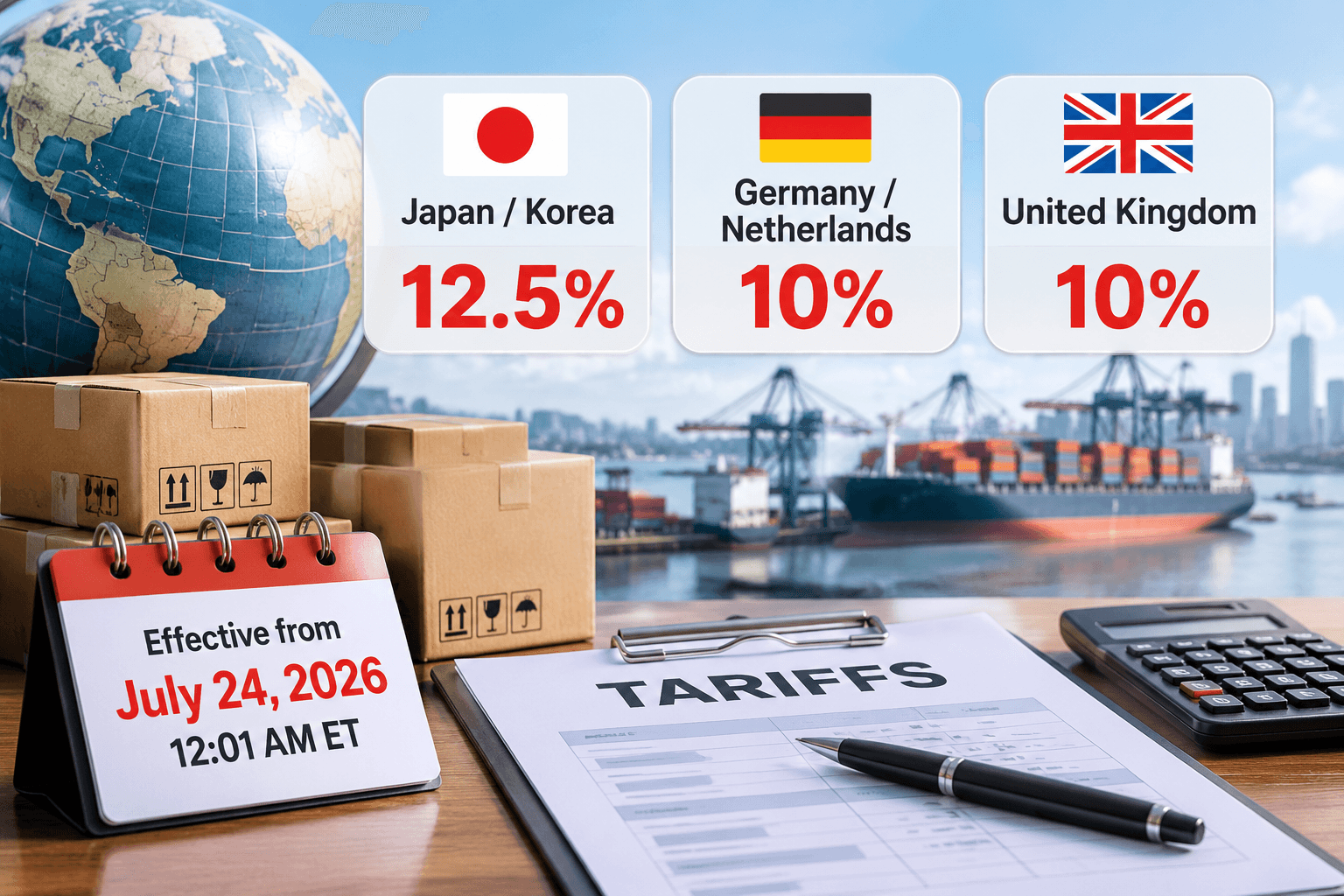
The Section 301 schedule is the one an equipment buyer has to model line by line, because the rate depends on where the seller sits. Goods of Argentina, Bangladesh, Cambodia, Canada, Ecuador, El Salvador, Guatemala, Honduras, India, Indonesia, Jordan, Malaysia, Mexico, Pakistan, Sri Lanka, Trinidad and Tobago and the United Kingdom carry 10%. For the European Union and Taiwan the rule is a top-up: where the MFN tariff is below 10%, the Section 301 duty is set so that the two together equal 10%, and where the MFN rate is already at or above 10% the Section 301 duty is zero. Japan, Korea and Switzerland work the same way but to a 12.5% total. Every other investigated economy carries 12.5%.
Put in the terms a procurement manager actually uses: a refurbished system bought from a Japanese or Korean seller is priced against a 12.5% cap, one from Germany or the Netherlands against a 10% cap, and one invoiced through the United Kingdom against a flat 10%. Those are totals net of the ordinary duty, not additions to it. The additional rates apply to goods entered for consumption on or after 12:01 a.m. eastern time on 24 July 2026, which is also the boundary the refund clause later picks up11.
The Section 122 surcharge is the older and blunter instrument: 10% ad valorem on imports generally, imposed for 150 days from 24 February 2026, additional to duties already applicable except where Section 232 duties cover the same part of an import, and treated as a regular customs duty. The statute behind it allows a surcharge of up to 15% ad valorem for no more than 150 days unless Congress extends it. Its exemption list is where the medical question sits.
Medical devices asked for an exemption, and the answer was no
During the comment period on the Section 301 action, importers asked USTR to exempt products that have limited or no domestic supply. Medical devices were named in that group, alongside decorations, frozen seafood and sporting goods. The final notice answers the request in a section headed "Determination Not To Exempt Additional Products", finding that "the goods above and other goods do not warrant exemption", reasoning that most availability-based requests concerned inputs or consumer goods, and noting that the tariffs top out at 12.5%12.
Read that as a fact about the record rather than a prediction. The exemption annexes to the notice resolve per economy and per HTS line, so whether a specific scanner, probe or part is caught is a question for the annex covering that economy — not for a general article. What the notice does settle is that a medical-device carve-out was argued on supply grounds and refused. Any landed-cost model built before July 2026 and never revisited is now the weak point in the file.
The Section 122 exemption list points the same way. It covers critical minerals, metals used in currency, energy, certain natural resources and fertilisers, certain agricultural goods, pharmaceuticals and pharmaceutical ingredients, certain electronics, vehicles, aerospace products, information materials and baggage, articles already carrying Section 232 duties, goods of Canada or Mexico entered free of duty under the USMCA rules of origin, and certain CAFTA-DR textiles13. Pharmaceuticals are named. Imaging hardware is not named as its own category, which is why the annexes, not the summary sentence, decide your line.
The refund clause is the part to read twice
Section 5 of S. 5390 is the only provision in the three bills that reaches backwards. It directs the Commissioner of Customs and Border Protection, not later than 30 days after enactment, to "automatically refund, with interest" the duties described, and it forbids the agency from requiring an importer to make an explicit request or submit documentation to receive the money14. It also gives the Commissioner authority to reliquidate entries that were already liquidated, and directs priority for small business concerns to the extent practicable.
Two dates govern who is covered. For the Section 301 forced-labour duties, refunds run to duties collected during the period beginning 23 July 2026 and ending on the date of enactment. For duties imposed under Section 122 or Section 338, the period begins 1 August 202615.
That second window deserves a flag. The Section 122 surcharge reviewed above was proclaimed for 150 days from 24 February 2026, so a reader who adds the dates may find little or nothing collected under that authority inside the window the bill specifies. The bill text is the authority here, not this arithmetic: if your entries in that period carry no Section 122 duty, there is nothing to refund under that head, and the Section 301 window is the one that matters.
The clause also tells you what the whole exercise turns on. An "automatic" refund is only automatic if the government can see which duty was which. That is an entry-level data question, and the importer is the party holding the entry.
What it changes at the point of purchase
Four things follow for anyone buying used imaging equipment into the United States.
Asking price and landed cost have drifted further apart. Our own benchmark of used ultrasound listings reports asking prices and nothing else, because there is no verified transaction data behind a landed-cost figure16. Add a 10% or 12.5% duty line to a five-figure system and the gap between two identical listings in Rotterdam and Osaka stops being a rounding error. The benchmark's ranges are the right starting point and the wrong ending point.
The duty rate is an attribute of the seller's location, not of the machine. Two units of the same model and year can carry different totals because one is invoiced from a 10% economy and the other from a 12.5% one. That belongs in the comparison table next to condition, hours and probe count.
Say who owns a refund before you sign. A refund enacted after delivery belongs to whoever the contract says it belongs to. If the sale is on delivered-duty-paid terms, the seller paid the duty and the claim is theirs unless assigned. If it is on an ex-works or FOB basis and you are the importer of record, it is yours — provided the entry can be produced. One sentence in the purchase agreement settles it; the default does not.
Do not price a refund into the offer. Nothing in these three bills is law, and the discounted price you negotiate today is real whether or not the refund ever arrives.
Six records to keep from today
- The entry summary for each shipment, with the HTS line and the duty amount split by authority — MFN, Section 301, Section 122, Section 338.
- Your broker's classification rationale in writing, with the ruling or interpretive rule it rests on.
- The annex pages that cover your line, per economy, with the date you checked them.
- The origin documentation — USMCA certificate or otherwise — dated at import.
- The commercial invoice and the clause of the purchase contract that allocates duties and any refund.
- A dated note of the day you checked the annexes, because they move. The Canada Section 338 instruments were amended more than once through the second half of 2026, including a temporary suspension published on 24 August 202617.
None of these records costs anything to keep. All of them are expensive to reconstruct.
What would have to happen before any of this bites
A bill in committee needs to clear its committee, pass its chamber, pass the other chamber, and be signed. A presidential veto requires a two-thirds vote in each chamber to override18. As of this writing, all three sit where the table above puts them: referred, unamended on the floor, with no recorded vote to schedule.
The reported read from trade lawyers, in coverage by MedTech Dive, is that businesses should watch the progress of the three bills and that there is more bipartisan appetite for tariff limits than the current Congress has shown19. That is a source's judgement, reported rather than verified here. The verifiable part is the bill text and the Federal Register record of what is being collected today.
The verdict for a buyer: change nothing about your price, and change everything about your paperwork. The duties in force are documented, the exemption request that failed is documented, and the refund mechanism that would follow enactment is date-bounded and entry-based. If the bills die in committee, a clean entry file still pays for itself at audit. If one becomes law, it is the only thing that gets you paid.
Related on MedTrade: used ultrasound price benchmarks 2026 for asking prices by probe and system class, how to verify medical equipment suppliers for the cross-border due-diligence steps that sit around the import file, and refurbished vs new MRI and CT: ROI buying guide for where a landed-cost line belongs in the model.
Sources
Every figure in this article is taken either from the text of a bill on govinfo or congress.gov, or from a Federal Register document identified by citation and page. No rate is estimated and no figure is attributed to a vendor. The one point that rests on press reporting is marked as reported in both the text and its note. All documents were retrieved on 16 November 2026; the Federal Register record changes, so a later re-run may show different scope.