In May 2026, Deloitte's Center for Health Solutions published a report with an understated title: "Rethinking Customer Engagement in Diagnostics." The numbers inside are anything but understated. After surveying 50 diagnostics manufacturer executives and 50 hospital and lab leaders, plus conducting 20 in-depth interviews across manufacturers, providers, wearable-tech companies, and venture capital firms, Deloitte reached a conclusion the equipment industry needs to take seriously: how diagnostic devices get bought and sold is being reshaped by end consumers — and most manufacturers haven't caught up.1
If you're a medical equipment dealer, a refurbished-device reseller, or a hospital procurement decision-maker, this report isn't about someone else's industry. It's about your suppliers changing, your customers changing, and the logic you use to decide what to buy changing with them.
One Report, Three Disconnects — What Deloitte Actually Found
Deloitte's core finding can be summarized in a single sentence: diagnostics manufacturers and hospital buyers live in different worlds. Not because one side is wrong — but because three systemic misalignments separate them. Every one of these misalignments has direct consequences for equipment purchasing decisions.
Misalignment One: Manufacturers Are Solving Result Interpretation. Hospitals Are Fighting Test Ordering.
When Deloitte asked both sides to identify the biggest friction point in the diagnostic journey, the answers didn't match. Hospitals pointed to test ordering — how a clinician decides which test to run, when to order it, and how the result loops back into the clinical workflow. That's a frontline operational headache.
Manufacturers pointed to result interpretation — how test data gets displayed, analyzed, and used to support diagnosis. This happens to be the part of the workflow closest to their own products, so the focus is understandable.
The problem: if a hospital's biggest pain point is "making it easy for our clinicians to order the right test at the right time," and your solution is "once the test is done, we have a better AI dashboard for reading the results" — you're solving different problems. For anyone buying equipment, this means one thing: don't evaluate a device on the features the manufacturer highlights. Ask whether it fits into your actual clinical workflow. If the answer is "I'm not sure," no spec sheet makes up for it.
Misalignment Two: Manufacturers Court Procurement. Clinicians Make the Actual Decisions.
This is the misalignment that's easiest to overlook — and most expensive to ignore.
Deloitte's survey is explicit: manufacturers named hospital procurement offices and channel partners as their primary contacts. These are the people who sign contracts, manage budgets, and push paperwork through approval chains. But hospitals said the people who actually influence equipment selection are ordering clinicians, lab directors, and service-line leaders — the people who use the devices every day and know which machine produces reliable results and which one generates 3 a.m. service calls.
One sentence to remember: manufacturers are building relationships with the people who approve purchases while underinvesting in the people who shape adoption.
For equipment dealers and resellers, the implication is straightforward. If your outreach strategy begins and ends with the procurement office — pricing, payment terms, delivery schedules — someone else is having coffee with the lab director. And the lab director's opinion carries more weight in model selection than the procurement office's spreadsheet ever will.
Misalignment Three: Manufacturers Bet on Field Sales. Hospitals Want Peer Networks and Self-Service Websites.
The third disconnect is about how information reaches buyers. Deloitte found that manufacturers prioritize field sales teams and application scientists — boots on the ground, in-person demos, relationship-building visits. Hospital buyers described this outreach as "too frequent and not always valuable."
What do they want instead? Two things: peer-to-peer exchange and education — conferences, clinical forums, colleague conversations — and better self-service websites where they can research specs, compare parameters, and verify compatibility without taking a sales call.
For equipment dealers, this has two layers. Layer one: if your product information isn't findable online — or is findable but doesn't match the model someone is searching for — you already lost the moment a clinician opened their browser. Layer two: peer reputation and conference presence are becoming more effective than sales visits. That's not a prediction. It's what Deloitte's data shows, right now.
⚠️ Data attribution: The three-misalignment findings come from Deloitte Center for Health Solutions, "Rethinking Customer Engagement in Diagnostics: Are Manufacturers Prepared?" published May 27, 2026. Methodology: 50 manufacturer executives + 50 hospital/lab provider surveys (February 2026), plus 20 in-depth leader interviews. Not independently verified by MedTrade.
92% of Providers Already Offer Patient-Initiated Testing — The Equipment Shopping List Is Being Rewritten
If the three misalignments tell a story about a supply side that isn't ready, this next number tells a story about a demand side that stopped waiting. The most striking statistic in Deloitte's report: 92% of provider respondents are already offering or exploring patient-initiated testing. Not "considering it." Not "planning to." Already doing it.
Not "Should We?" — "We Already Are."
Patient-initiated testing covers more ground than most people assume. Consumer finger-prick platforms (LetsGetChecked, Everlywell). Wearables (the Oura ring, Ultrahuman glucose monitoring). Hospital-built patient portals that let people schedule their own lab work. Patients are bypassing the traditional physician-order pathway, and it's becoming the default, not the exception.
Deloitte cites a survey of 1,000 U.S. patients conducted by a diagnostics manufacturer: 93% expect their doctor to order a lab test upon request. 27% pursue testing without a doctor's recommendation at all. These aren't edge cases. They're the new mainstream.
70% of Manufacturers Are Still Watching — The 22-Point Gap
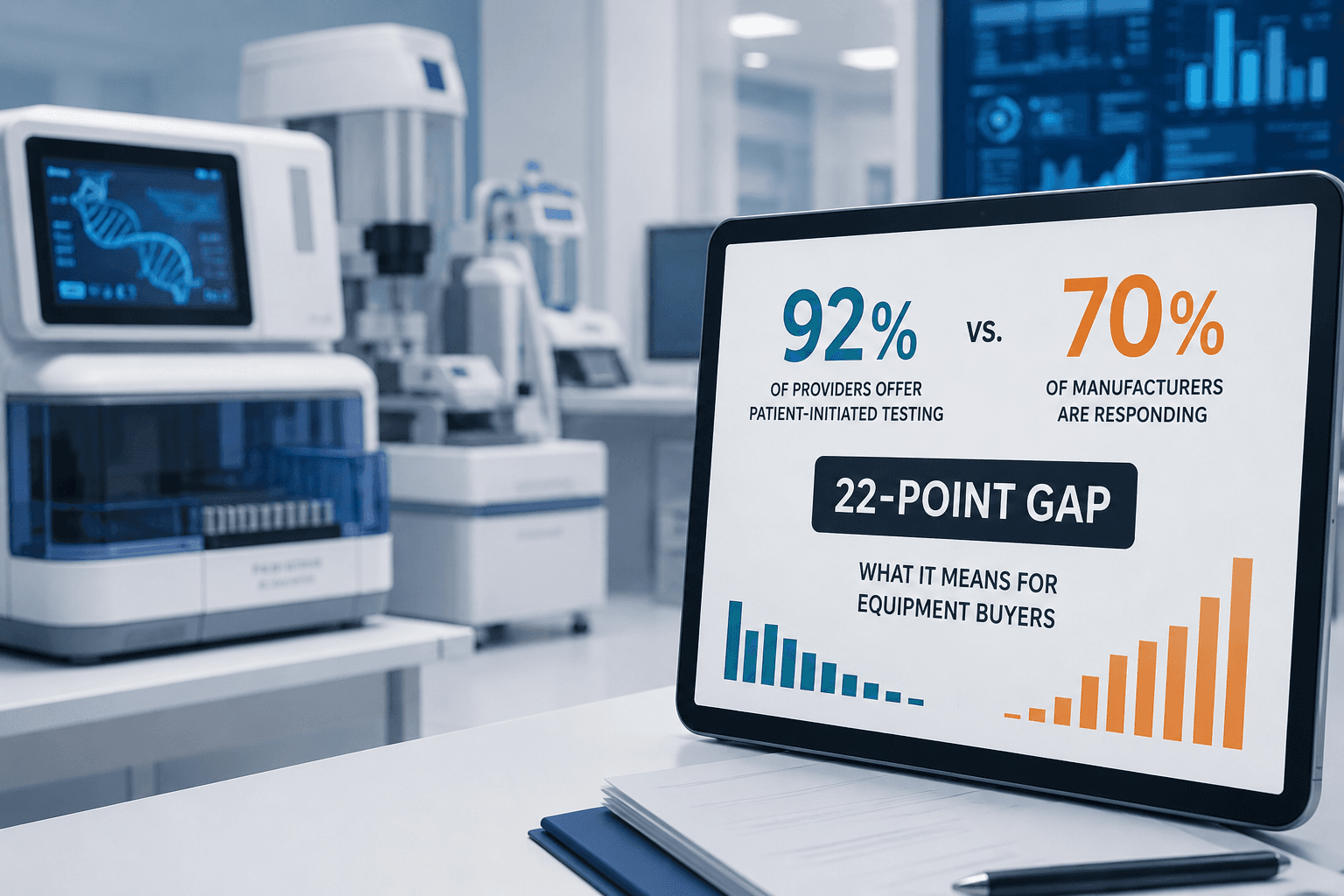
Here's where the numbers get interesting. 92% of providers are already moving on patient-initiated testing. Only 70% of manufacturers say the same. The gap between those two numbers — 22 percentage points — isn't statistical noise. It's a market window.
For equipment dealers, the meaning of that gap is direct: demand is running ahead of supply. Hospitals need equipment to support patient-initiated testing workflows — sample collection, data transmission, result delivery to patient apps — but manufacturers are still catching up on the product side. Suppliers who get their listings in front of buyers now, with clear information about patient-testing compatibility, capture demand that competitors aren't ready to serve.
Patient-Initiated Testing Requires a System, Not Just a Device
The natural instinct is to think "patient-initiated testing = new testing instruments." Portable analyzers. Wearable sensors. Point-of-care devices. But Deloitte's data points to a deeper problem: 74% of providers said their systems aren't yet integrated across the end-to-end diagnostic journey.
Here's what that actually means. Say you buy a new chemistry analyzer that supports patient self-scheduling — the patient books online, comes in for the draw, the machine runs the test, the result comes out. Now what? How does the result get pushed to the patient's phone? Can it auto-populate the EHR? If the result is abnormal, who notifies the patient and who schedules the follow-up?
Patient-initiated testing isn't a device procurement problem. It's a device + data integration + patient communication + follow-up routing problem. That means purchasing decisions stop being single-department affairs. The lab needs the hardware. IT needs the API. Clinical operations need the workflow. The era of a manufacturer dropping off a machine and walking away is ending.
Who Signs the Check Matters Less Than Who Picks the Model — The Procurement Power Map Is Being Redrawn
That second misalignment — manufacturers targeting procurement while clinicians hold the real influence — deserves its own section. Because it changes where equipment dealers should spend their time.
Procurement Signs the PO. Clinicians Choose the Machine.
Deloitte's finding is unambiguous: manufacturers' key relationships sit with procurement offices and channel partners. These people control budgets, manage approval chains, and keep the purchasing process compliant. They are the gatekeepers of the transaction. But hospitals told Deloitte that the stakeholders who actually shape equipment selection are ordering clinicians, lab directors, and service-line leaders. They are the opinion leaders of model choice.
This isn't about one group having more power than the other. It's about different stages of the decision. Procurement decides whether the purchase can happen — is the budget there, is the supplier qualified, does the paperwork check out. Clinicians decide which model to buy — does this MRI coil set cover the scans our department runs every day, does this analyzer's test menu include the panels we order most often, does this ventilator handle the patient population we actually see.
A common failure mode: a dealer spends weeks securing procurement's budget approval, only to discover the lab director already locked in on a competing model after seeing it presented at a conference — and nobody thought to include the dealer in that conversation.
Three Ways to Reach Clinical Decision-Makers
Deloitte's survey surfaced three channels that hospital buyers consistently value — and that manufacturers consistently underinvest in:
- Peer-to-peer exchange and education. Conferences, clinical forums, inter-departmental experience sharing — these are the information sources clinical decision-makers trust most. If you can bring objective clinical comparison data to those conversations — not sales pitches, but actual side-by-side performance metrics across models — the business card you hand over during a conference coffee break does more work than three cold sales visits.
- Self-service product research websites. A clinician's first step when researching equipment isn't dialing a sales rep. It's opening a search engine. Can your product page be found? When it's found, is the information structured — specs, compatibility, real installation cases? Deloitte's respondents were explicit: they want a website experience where they can complete initial research "without taking a sales call."
- Clinical data comparisons. Not "our brand beats the competition" — clinicians have heard that ten thousand times. They want objective parameter comparison tables across brands in the same device category, actual failure-rate data in practice, feedback from other hospitals running the same model.
💡 We've spoken with procurement managers who say the most common complaint isn't "we didn't have enough budget." It's "the equipment we bought sits underutilized because the clinical staff doesn't like using it." The root cause sits in the procurement process: procurement decides with spreadsheets, clinicians decide with the first patient of the morning. The distance between those two decision standards is the length of an entire hospital corridor — and someone needs to walk it.
LetsGetChecked, Everlywell, and Oura Are Here — Nontraditional Buyers Are Changing How Equipment Gets Bought
There's a group Deloitte's report mentions that's easy to skip past: nontraditional players. Consumer testing companies (LetsGetChecked, Everlywell). Wearable manufacturers (Oura, Ultrahuman). AI-driven health platforms that don't own a single white coat but are steadily taking share from traditional diagnostics.2
Consumer Health Companies Buy Equipment Differently From Hospitals
A community hospital buys a chemistry analyzer like this: department submits a request → procurement issues an RFP → three vendors bid → administration approves → contract signed. Timeline: 3 to 6 months.
A consumer testing company buys equipment like this: CTO and head of operations review specs → run a trial → decide. Timeline: potentially one month.
These new buyers share a few traits: they decide fast, they don't care about traditional brand hierarchy, and they care deeply about API compatibility and data interoperability. They need devices that don't just run tests — they need devices that output structured data to their own consumer app, integrate with third-party logistics, and plug into patient notification systems. If a traditional manufacturer's entire value proposition is "our hardware is better," that's a thin deck in front of this buyer.
Regulation Isn't Slowing Consumerization — It's Accelerating It
Deloitte flags two policy signals: CMS Innovation Center's ACCESS Model and FDA's TEMPO for Digital Health Devices Pilot. The short version: regulators are building compliance pathways for consumer-grade diagnostic products, not blocking them. Consumerization isn't a passing trend. It's being codified into formal policy frameworks.
What New Buyers Want: Modular, API-Friendly, White-Label-Ready
If you're an equipment dealer trying to capture demand from this emerging buyer segment, you need to understand that their procurement language is fundamentally different from a hospital's:
For suppliers, a practical takeaway: if your product listings clearly surface API compatibility, data output formats, and FHIR support status, you're already ahead of competitors who haven't realized this buyer exists — and you're speaking their language before they even ask.
⚠️ Case attribution: LetsGetChecked, Everlywell, Oura, and Ultrahuman are cited as industry examples in the Deloitte report referenced above. They are not MedTrade-tested or endorsed. Roche navify and the Quest Diagnostics-Epic collaboration are similarly cited from the Deloitte report. All trademarked names belong to their respective owners.
When Hospitals Upgrade Their Labs for B2B2C, Where Does the Old Equipment Go?
Deloitte's report is written for manufacturers asking "how should we adapt to B2B2C?" But there's an implication they don't spell out: B2B2C transformation means equipment refresh cycles. Equipment refresh cycles mean secondary-market supply.
B2B2C Transformation = Equipment Refresh Cycle
When a hospital decides to upgrade its lab capabilities to support patient-initiated testing, it's not swapping out one device. Patient self-scheduling requires specimen tracking systems. Data integration requires middleware. Result delivery requires patient-facing interfaces. If the hospital's existing equipment can't support these capabilities, it gets replaced.
Deloitte's data corroborates this indirectly: 74% of systems aren't integrated, and 66% of respondents say personalized workflow integration will be very important in the next 3–5 years. Those two numbers together tell one story: a significant volume of existing equipment will be replaced in the coming years because it can't talk to anything else.
Replaced Equipment Isn't Scrap
For equipment dealers and refurbished-device resellers, the signal here has a clear direction: replaced equipment has a predictable destination. The devices a large health system retires are often the target acquisition for a community hospital, an independent imaging center, or a veterinary practice. And when those buyers evaluate a used device, the hardest problem isn't finding one — it's answering two questions: Can I verify this device's repair history? Can I verify this supplier's identity?
💡 The hardest part of buying used medical equipment isn't locating the device. It's establishing trust. A PDF service record can be altered by anyone with a PDF editor in under five minutes. What you actually need: ① a technical mechanism that proves this repair record came from this supplier — like a public Repair Report with a server-signed URL; ② a public record that confirms this supplier's credentials were reviewed by someone independent. Without those two things, any discount you negotiate is just a bet.
The Structural Opportunity in the Secondary Market
An equipment refresh wave creates three layers of impact on the secondary market:
For buyers, the key is this: when the replacement wave arrives, know where to look, know how to verify what you find, and know how to compare — instead of rolling the dice on a PDF and a handshake.
AI + FHIR + Interoperability — "Personalized Workflow Integration" Isn't a Buzzword. It's a Hidden Procurement Checklist.
There's a section in the Deloitte report that's easy to skim past. If you're making equipment purchasing decisions, it might be the most valuable part of the entire document.
74% of Systems Aren't Connected — What Does That Force You to Buy?
"Systems aren't integrated across the end-to-end diagnostic journey." Translated into procurement language: your hospital will need to buy at least three categories of things to close this gap.
- Data integration middleware. Software that converts data from different manufacturers' devices — different generations, different protocols — into a unified format. FHIR (Fast Healthcare Interoperability Resources, a modern healthcare data exchange standard that uses RESTful APIs and JSON instead of legacy HL7 pipe communication) is becoming the default. Buy a device without confirming FHIR compatibility, and you're buying an asset that procurement standards may render obsolete within 3–5 years.
- Patient interaction endpoints. The interfaces that let patients view results on their phones, schedule their own tests, and receive follow-up reminders. These aren't "nice-to-have" add-ons. They're the infrastructure layer beneath the 92% of hospitals already doing patient-initiated testing.
- Workflow automation tools. Software that routes the diagnostic journey — order → collect → test → report → follow up — without a human manually handing off each step. Deloitte's report mentions "Next-Best-Action Routing": AI determining what should happen after a result comes back, then notifying the right person automatically.
FHIR Isn't Just an IT Problem
A lot of procurement decision-makers hear "FHIR" and think "that's IT's problem." The reality: the device you buy either connects to a FHIR-based ecosystem, or it becomes an information island. Deloitte notes the transition from HL7 to FHIR is accelerating. HL7 — the older standard, based on pipe communication with poor cross-vendor compatibility — is being replaced by FHIR, which uses modern web architecture. A FHIR-compatible device produces data that any FHIR-compatible system can read. A non-FHIR device produces data that might not leave its own screen.
If you're buying a diagnostic instrument in 2026 and you haven't confirmed FHIR support, you're betting the hospital won't upgrade its EHR or patient portal in the next three years. That's a bet you'll probably lose.
AI Isn't a Selling Point Anymore. It's a Procurement Criterion.
Deloitte's survey shows 66% of respondents believe personalized workflow integration will be very important in the next 3–5 years. Note the phrasing — not "AI-assisted diagnosis is important," but "embedding AI into workflows is important." The distinction matters. One is a feature on a product sheet. The other is an evaluation dimension for purchasing.
Here are the AI-related procurement criteria that are shifting from "bonus" to "baseline":
⚠️ Data attribution: 74% and 66% figures from Deloitte 2026 industry survey (50 manufacturers + 50 provider surveys, February 2026). FHIR trend characterization reflects industry consensus and is not a device purchasing recommendation. Verify specific device FHIR compatibility against manufacturer documentation.
What the Report Gives You Isn't Data — It's a Direction
Deloitte's report takes ten minutes to read. Inside it are three action directions that are directly usable for anyone in medical equipment procurement.
If you're a buyer — hospital procurement, equipment dealer, refurbished-device reseller:
The rules of diagnostics procurement are changing. Not because B2B is dead — but because B2B2C injected patient preferences directly into the purchasing chain. That means when you evaluate equipment, brand and price aren't enough. You also need to ask: can it connect to the hospital's information systems (FHIR compatibility)? Does it have verifiable repair records (not a PDF)? Has the supplier's credentials been independently reviewed (Verified Supplier badge)?
The simplest move: next time you evaluate a device, add three questions to your inquiry. "FHIR-compatible?" "Public Repair Report available?" "Supplier credentials independently verified?" If the answer to all three is no, you know what to do.
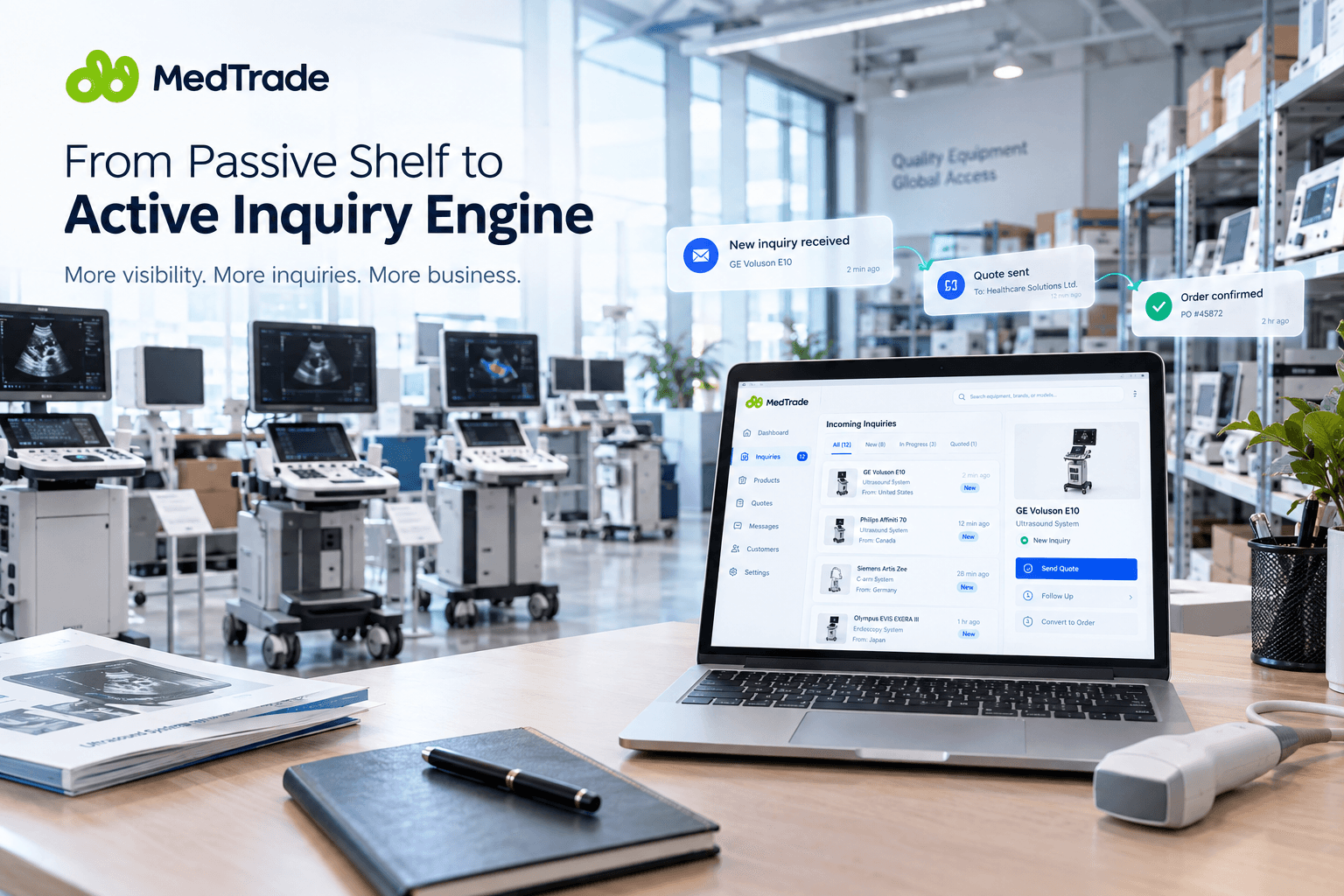
Search for diagnostic equipment by model on MedTrade, send an inquiry to verified suppliers, and compare quotes before deciding. Before you look at the price, look for the green shield on the supplier's profile.
If you're a supplier — manufacturer, refurbisher, parts distributor:
A 22-percentage-point gap between provider demand and manufacturer response isn't theory. 92% of hospitals are building patient-initiated testing capabilities. 70% of manufacturers have productized for it. The gap is a window. Consumer health companies and wearable manufacturers are becoming a new buyer category — they decide faster, don't worship legacy brands, and care deeply about API integration and data interoperability.
The simplest move: audit your product listings. Is FHIR compatibility listed? Have you created Repair Reports to build buyer confidence? Have you uploaded credentials for the Verified Supplier badge? If your product page has one photo and the words "Good Condition" — your competitor is already taking your inquiries with structured data.
List products on MedTrade. Create Repair Reports. Upload credentials and earn the Verified Supplier badge. Buyers filter by these three signals when they search. Suppliers without signals rank at the bottom.