In 2026, a neurosurgeon-founded startup used a wireless earpiece to cut a deadly ICU complication rate by over 40%. The data came from WashU Medicine, not a pitch deck. But a technology's clinical story is never about which device has the cleverest engineering — it's about which setting it works in, who can actually use it, and at what total cost.
This article uses Aurenar's V-Link as a flagship case study to map the non-invasive neuromodulation landscape in 2026. The goal isn't to round up funding rounds. It's to answer the question hospital buyers actually need answered: which of these technologies are moving from journal articles to purchase orders?
Non-Invasive Neuromodulation in 2026 — What's Actually in Clinical Use?
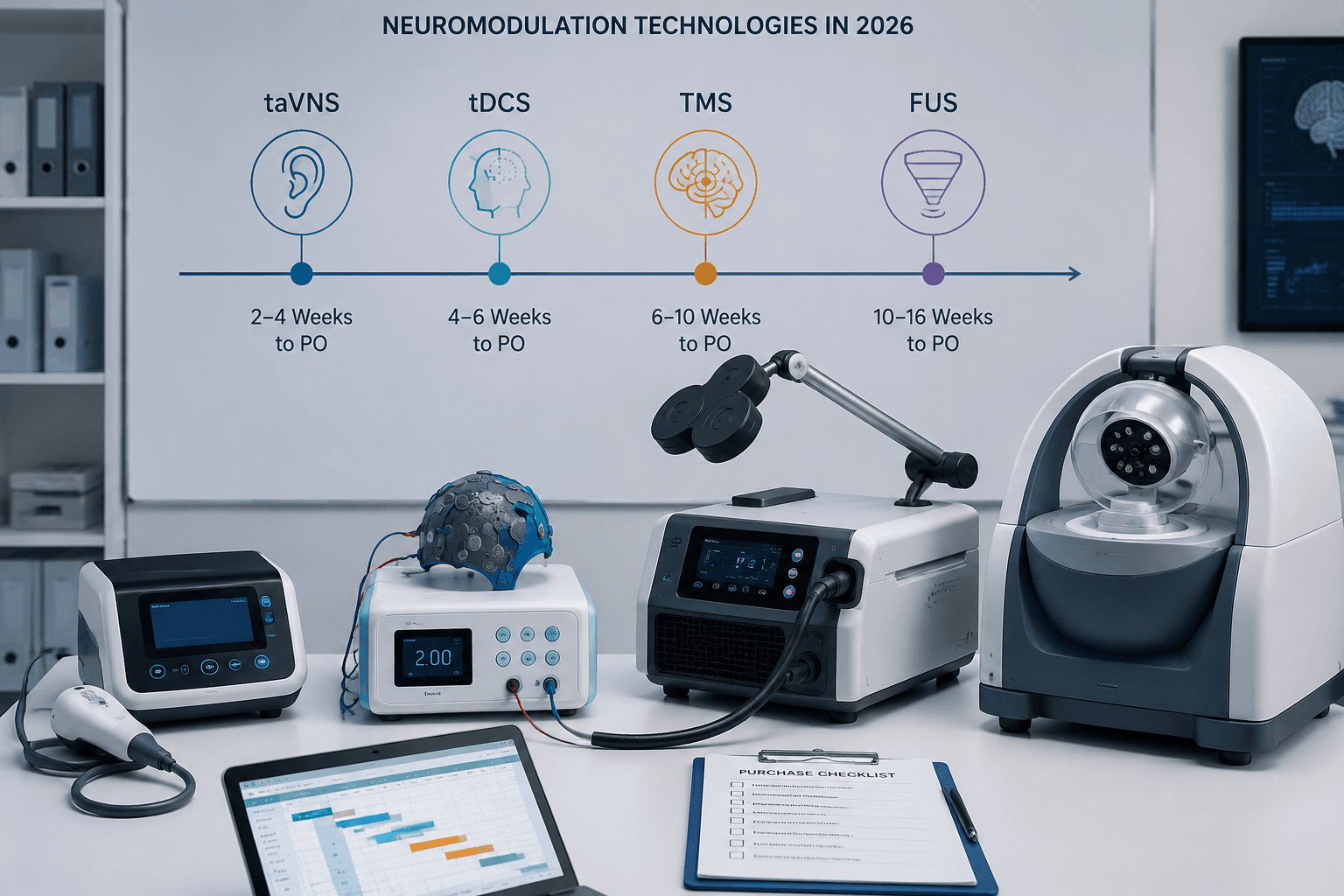
The non-invasive neuromodulation field in 2026 has settled into a clear four-way split: one technology has reached the stroke ICU, another has spent years building evidence in psychiatry, a third is climbing the steep slope from benchtop to clinical data, and a fourth is physically the most elegant but still assembling its proof. What they share is "no surgery required." Where they diverge — dramatically — is clinical maturity and procurement relevance.
taVNS — From Epilepsy to the Stroke ICU, 2026's Most Important Clinical Expansion
taVNS (transauricular vagus nerve stimulation) works on a deceptively simple principle: a small patch of skin on the outer ear happens to be innervated by the auricular branch of the vagus nerve — the only point where the vagus reaches the body surface. Clip an electrode onto that spot, deliver a weak electrical pulse, and you modulate the brainstem's autonomic nuclei through the vagal afferent pathway. No surgical implant. No vascular access. The patient is awake.
For the past decade, taVNS clinical evidence clustered around drug-resistant epilepsy and treatment-resistant depression. The shift in 2026 is that the indication expansion is pointing toward acute critical care — specifically, prevention of cerebral vasospasm after aSAH (aneurysmal subarachnoid hemorrhage). The logic holds: vagus nerve stimulation is known to suppress systemic inflammation, and post-aSAH vasospasm is fundamentally an inflammation-driven process. The question was whether anyone would put a device that looks like consumer electronics into an ICU and try to change stroke outcomes. Aurenar went first. The evidence is in the next section.
tDCS — Years Into Psychiatry Approvals. What's the Next Growth Vector?
tDCS (transcranial direct current stimulation) has the lowest technical barrier to entry of the four: a pair of scalp electrodes, a battery-level current (1–2 mA), and a simple constant-current circuit. It doesn't trigger action potentials. Instead, it shifts cortical neurons' resting membrane potential — excitation or inhibition depending on whether the anode or cathode faces the target region.
tDCS has amassed the largest RCT literature of any non-invasive neuromodulation technology, spanning depression, post-stroke motor recovery, and chronic pain. Home-use tDCS devices have earned CE marks for adjunctive depression treatment in Europe. But the weakness is equally well-documented: the effect size is modest and inter-individual variability is enormous. The same stimulation parameters applied to two people of different age, sex, and skull thickness can produce cortical current distributions that differ by a factor of two. The 2026 consensus is that tDCS has clinical value, but the personalization problem — who to treat, with what parameters — is far from solved. That puts it lower on the hospital procurement priority list.
TMS — The Most Mature Technology, but Device Footprint and Per-Session Cost Still Gatekeep Procurement
TMS (transcranial magnetic stimulation) is the most commercially established of the four. The FDA approved TMS for drug-resistant major depressive disorder in 2008 and extended the label to obsessive-compulsive disorder in 2018. By 2026, the major players — Magstim, BrainsWay, NeuroStar — are on their third or fourth device generations.
The procurement headache with TMS isn't efficacy. It's operational economics. A TMS unit typically costs between $30,000 and $100,000, requires a dedicated operator and a fixed treatment room, and each session runs 20–40 minutes. A standard course means the patient comes in 3–5 times a week for 4–6 weeks. For a department head, this isn't a device purchase — it's a service line launch. Smaller hospitals and psychiatric practices often lease rather than buy.
Focused Ultrasound — It Bypasses the Blood-Brain Barrier, but the Evidence Climb Isn't Over
Focused ultrasound (FUS) is the most physically elegant of the four technologies: an extracorporeal transducer array steers ultrasound beams to a millimeter-scale target inside the brain, transiently opening the blood-brain barrier for targeted drug delivery or creating a thermal lesion for non-invasive ablation. By 2026, the FDA has approved FUS for thalamotomy in essential tremor and Parkinson's disease.
FUS faces two practical barriers to wider adoption. First, it requires real-time MRI guidance for targeting and thermometry — which means the purchase of FUS presupposes the presence or simultaneous acquisition of a high-field MRI. Second, the per-treatment cost is extremely high: a full FUS system with the integrated MRI solution can exceed $2 million, and current installations are concentrated in large academic medical centers.
💡 Expert Insight: If you're evaluating a non-invasive neuromodulation device for procurement, start with one question: does this device work standalone, or does it depend on imaging? TMS and tDCS are standalone. FUS is imaging-dependent. taVNS sits between them — acute-phase use requires imaging for diagnosis, but the therapy itself doesn't need imaging guidance. For imaging-dependent devices, your total acquisition cost needs to include the imaging hardware and the radiology staff time. Device sales representatives won't volunteer that math.
V-Link and the Stroke ICU — Aurenar's $5.7M Bet on taVNS
Aurenar is not a big company. In July 2026, it closed a $5.7 million oversubscribed seed round, co-led by the Go Red for Women Venture Fund (American Heart Association Ventures) and Solas BioVentures, with participation from BJC Health and Kaleida Capital. The dollar amount is unremarkable in medical device fundraising. The backers are worth paying attention to: AHA's venture arm almost exclusively funds "clinically validated unmet needs," not concept-stage bets.
V-Link Under the Hood — How a Disposable Wireless Earpiece Replaces Invasive Neurostimulation
V-Link is a single-use, wireless ear-clip electrode that connects via Bluetooth to a bedside control unit. It delivers programmed electrical pulses to vagal afferent fibers through the auricular branch (Arnold's nerve — the only vagal branch that reaches the skin surface). Three design choices define its clinical positioning:
- Single-use, not reusable — zero sterilization cost, zero nosocomial infection risk, compatible with ICU infection-control protocols
- Wireless, not tethered — the patient isn't pinned to the bed by a bundle of leads. Nursing procedures (turning, suctioning, transport to CT) don't interrupt therapy
- Pre-set protocols, not neurosurgeon-operated — an ICU nurse can place the earpiece and start therapy after training. No OR time. No interventional suite
⚠️ Watch Out: V-Link is currently for investigational use only. Aurenar has not yet submitted a PMA (Premarket Approval) application to the FDA. What it holds is a Breakthrough Device designation — an accelerated review pathway, not a marketing authorization. Between these two things sits an entire Pivotal Trial.
Reading the WashU Data — Vasospasm ↓40%, Hospital Costs ↓20%. Who Was in the Study, and Who Wasn't?
A Washington University School of Medicine team ran a prospective study in aSAH patients and reported the following endpoint data 1:
These numbers deserve attention. Three things also deserve attention:
First, the inclusion criteria. The current study enrolled Hunt-Hess Grade I–III (mild-to-moderate) aSAH patients. Grade IV–V patients — the highest-acuity cohort — were not included. The data cannot be extrapolated to the sickest patients.
Second, single-center data. WashU's results need replication in a multicenter Pivotal Trial before they can support a PMA submission. Single-center effect sizes are routinely larger than multicenter ones because single centers have tighter control over patient selection, operator consistency, and follow-up management.
Third, surrogate endpoints vs. clinical outcomes. Vasospasm incidence and cytokine levels are surrogate markers. The 30-day mRS improvement is encouraging, but what the field wants to see is 90-day functional independence — the hard endpoint the FDA typically requires for PMA in stroke intervention devices.
The FDA Breakthrough Device Timeline — From Designation to PMA, Step by Step
V-Link received FDA Breakthrough Device designation on June 30, 2026. What this designation actually provides:
- More frequent interaction between the FDA review team and the sponsor (including biweekly calls and rapid written feedback)
- Acceptance of more flexible clinical evidence (not necessarily a traditional double-blind RCT — historical controls or Bayesian adaptive designs may be acceptable)
- Priority review: once the PMA is submitted, it moves ahead of standard submissions in the review queue
What it does not shorten is the time from today to PMA submission. That interval is dominated by Pivotal Trial enrollment and data lock. For an indication like aSAH, with an annual incidence of roughly 6–10 per 100,000, enrollment velocity is the binding constraint. A reasonable estimate: Pivotal Trial launch (2027) → enrollment complete + data lock (2029–2030) → PMA submission → FDA review + possible advisory panel (2030–2031). In other words, the earliest V-Link appears on a U.S. hospital procurement list is around 2030.
From aSAH to Traumatic Brain Injury — The Adaptation Logic and Its Limits
Aurenar's long-term story follows the logic of taVNS's anti-inflammatory mechanism: expand along the axis of "acute brain injuries driven by inflammation" — from aSAH → traumatic brain injury (TBI) → hemorrhagic transformation prevention in ischemic stroke → post-cardiac-surgery cognitive dysfunction. Each new indication multiplies the theoretical TAM by an order of magnitude. Each new indication also requires its own clinical evidence. That's the long arc, and it matters for investors. For procurement purposes, the relevant timeline is aSAH only.
Invasive vs. Non-Invasive — Same River, Different Boats
The most interesting narrative tension in neuromodulation in 2026 isn't any single technology breakthrough. It's the parallel acceleration of two routes: invasive BCIs pushing toward higher signal resolution, and non-invasive neuromodulation pushing toward broader patient access. They're not competing on which technology is better. They're competing on which risk-benefit profile different patients are willing to accept.
The Risk Ladder — Every Step Down in Invasiveness Expands the Patient Pool by an Order of Magnitude
The arithmetic is brutal: Neuralink's signal resolution leads by orders of magnitude, but its addressable patient population is also smaller by three orders of magnitude. That doesn't make Neuralink irrelevant — for a locked-in patient, restoring the ability to type is a quality-of-life transformation. It does mean that, in a procurement-oriented article, we distinguish between "technologies worth tracking" and "technologies likely to appear on a purchase order in the next 12–24 months."
Synchron and Neuralink — Why They Chose the Harder Route
Synchron's technology path deserves its own paragraph, because its endovascular stent-electrode (Stentrode) pulled off a smart compromise on the invasiveness spectrum: a stent-shaped electrode array is delivered through the jugular vein into the superior sagittal sinus, overlying the motor cortex. The stent expands against the vessel wall and records neuronal signals from outside the blood vessel — no craniotomy, no penetration of brain parenchyma. The implantation procedure resembles what cardiovascular interventionalists do every day with venous stents.
By 2026, Synchron has completed enrollment in its U.S. pivotal trial and is the closest invasive BCI company to FDA approval. But its signal resolution — recording cortical potentials through the vessel wall — is far lower than Neuralink's intracortical microelectrode arrays. So what Synchron can currently achieve is "think-and-click" (cursor control), not what Neuralink has demonstrated in animal models — robotic arm manipulation or gait restoration.
💡 Expert Insight: A simple filter for deciding which technologies to track: ask what level of supporting infrastructure each one demands. Neuralink requires a neurosurgery team + intraoperative MRI/CT navigation + long-term post-implant programming. Synchron requires an interventional neuroradiology team + a DSA-capable angiography suite. taVNS requires a bedside control unit + ICU nurse training. What your hospital already has — and what it doesn't — determines which technologies belong on your radar. Media exposure isn't the metric.
It's Not Which Technology Wins — It's Which Indication and Patient Population Each Route Serves
The invasive route's core strength is signal resolution — for applications that require decoding fine motor intent from cortex (robotic arm control, cursor typing), non-invasive EEG/EMG simply doesn't have the bandwidth. The non-invasive route's core strength is accessibility — when the indication is "prevent secondary injury after acute brain insult" (like post-aSAH vasospasm), you don't need to read cortical signals. You need sustained vagal stimulation to suppress inflammation, and your patient may already be intubated, monitored, and repositioned every hour in an ICU bed. Craniotomy for electrode implantation is not a realistic option in that context.
These two routes will coexist. They'll eventually find their respective clinical homes in different indications and different patient populations. The question for a hospital buyer isn't "which route wins?" It's "does the route that fits my patient population have the evidence and the regulatory clearance to justify a purchase?"
The Imaging Bottleneck — Why Neuromodulation Runs on CT and MRI
Here's a question most neuromodulation articles never ask: aSAH diagnosis and vasospasm monitoring depend, from beginning to end, on imaging equipment. V-Link can suppress inflammation and vasospasm, but it has zero role in determining whether a patient needs treatment or whether the treatment is working. It generates no diagnostic information. CT angiography (CTA), MR angiography (MRA), and transcranial Doppler ultrasound (TCD) are the sensors on this clinical pathway — a dependency pattern that runs across medical imaging, from AI diagnostic tools to interventional navigation. (We covered the imaging-AI side of this equation in our analysis of AI medical imaging's 2026 clinical evidence.)
What does that mean in practice? Even if V-Link received FDA approval tomorrow, without the right imaging equipment to support it, its clinical value stays locked on the page.
The Overlooked Fact — No Image, No Treatment Window
The aSAH clinical pathway has three imaging-dependent nodes:
- Initial diagnosis — Patient presents with thunderclap headache → non-contrast CT confirms subarachnoid blood → CTA or DSA (digital subtraction angiography) localizes the aneurysm → endovascular coiling or surgical clipping
- Vasospasm surveillance — Post-procedure days 4–14 are the high-risk vasospasm window → daily TCD screening for flow velocity changes → CTA or DSA confirmation of moderate-to-severe spasm → V-Link or other intervention initiated
- Treatment response assessment — V-Link active → TCD continuously monitors whether flow velocities are falling → repeat CTA if needed to confirm vessel caliber changes
Every node is asking a question of imaging equipment. V-Link answers exactly one question: "how many minutes of vagal stimulation did we deliver?" That matters. It's not a diagnosis.
"We Bought the Neuromodulation Device but the CT Is Still a 16-Slice From 2012" — The Hidden Logic of Co-Procurement
This is a real procurement trap: a regional hospital wants to become a designated stroke center. It looks at taVNS and sees the low entry barrier — nurse-operated, non-invasive, disposable consumable — and calculates that the device and disposables budget is manageable. But its current CT is a 10-plus-year-old 16-slice scanner. CTA image quality from that machine is not reliable enough to diagnose and monitor vasospasm. CTA for vasospasm demands a 64-slice or higher configuration — thin-slice acquisition from C1 to the vertex in a single cardiac cycle, submillimeter reconstruction slice thickness.
What does this mean? It means that if the hospital decides to make taVNS a standard part of its stroke ICU protocol, it may need to upgrade its CT at the same time. Total acquisition cost ≈ taVNS device + CT upgrade + radiology staff training + endovascular coiling capability buildout (because the aneurysm itself must be secured — clipped or coiled — before V-Link can be used; V-Link prevents vasospasm, it doesn't treat the aneurysm).
This isn't an argument against buying neuromodulation devices. It's an argument against pricing them in isolation.
⚠️ Watch Out: Device sales representatives will usually tell you how effective their device is, how affordable, how easy to learn. They will not volunteer to do a companion-equipment gap analysis for you. Before you sign any letter of intent, get your radiology director and your stroke center director in the same room and walk through every clinical node on the pathway, checking each piece of equipment against what your hospital actually owns.
TCD vs. CTA vs. MRA — An Imaging Tool Selection Matrix for Different Budgets
For hospitals that already operate a 64-slice or better CT and a 1.5T or better MRI, the incremental imaging cost of adding taVNS is near zero — TCD serves as the daily monitoring tool, bedside, zero radiation, negligible consumable cost. For hospitals with aging imaging infrastructure, taVNS's hidden entry ticket could be hundreds of thousands to over a million dollars in imaging upgrades.
If you're evaluating TCD equipment specifically, probe selection matters — transducer frequency, footprint, and compatibility with your existing ultrasound system all affect whether a TCD unit actually gets used at the bedside or gathers dust. Our ultrasound transducer buying guide walks through the pre-purchase checklist for ultrasound probes, including the questions to ask suppliers before comparing quotes.
This is where MedTrade's role becomes concrete. If your hospital is evaluating an equipment upgrade for a stroke center — whether it's a 64-slice CT scanner, a 3T MRI for MRA capability, or a TCD unit for bedside monitoring — you don't need to lock in on one brand before you understand your options. You can search for equipment across brands (GE, Siemens, Philips, Toshiba), models, and technical specifications, and send inquiries to multiple verified suppliers simultaneously. Compare quotes. Ask questions. On the same platform, you can also find transcranial Doppler equipment — TCD suppliers are less concentrated than CT/MRI vendors, so the value of comparing multiple quotes is even higher.
A 2026–2028 Reference Timeline for Hospital Buyers
For hospital procurement decision-makers, non-invasive neuromodulation isn't a "should we buy?" question — the number of technologies that can realistically land on a purchase order today can be counted on one hand. It's a "when do we start tracking, when do we start evaluating, when do we start budgeting" question.
One Table — FDA Status, CE Mark, and Commercial Reality for All Four Technologies
Ranked — Which Technologies Are Most Likely to Hit Procurement Lists in 12–24 Months
- TMS (highest certainty) — If your hospital doesn't have TMS yet and has a psychiatry or neurology outpatient service, the procurement case can be built and approved within 12 months. Mature market. Multiple competing vendors. Flexible lease/purchase options.
- tDCS — home-to-hospital upgrade path — Home-use tDCS devices are transitioning from wellness gadgets toward prescription-grade medical devices. Watch Flow Neuroscience and competitors for hospital-grade product announcements.
- electroCore gammaCore (taVNS for headache) — FDA-cleared, large migraine and cluster headache patient base, short procurement justification cycle. Does not apply to the stroke ICU use case.
- FUS — large academic centers only — Total system cost exceeding $2 million. Installed base remains small. For most regional hospitals, the right strategy is "track, don't buy."
- V-Link (taVNS for aSAH) — track, don't buy yet — Until Pivotal Trial data is available, initiating a procurement process is premature. But track it — because if it gets approved, whether your hospital's imaging infrastructure can support it becomes the binding constraint.
Three Questions to Ask Before Signing Anything
Before you start the formal procurement process for any non-invasive neuromodulation device, run these three questions:
- "Is the clinical evidence from a patient population that looks like mine?" — If the evidence comes from a single-center study in carefully selected mild-to-moderate patients and your hospital receives transferred severe cases, the real-world effect size may shrink considerably.
- "What companion equipment needs to be upgraded at the same time?" — taVNS → CT/MRI/TCD + endovascular capability. FUS → high-field MRI + dedicated positioning frame. Sales representatives won't volunteer this list. Your radiology director will.
- "Can the supplier provide a Repair Report?" — If the imaging equipment you're procuring is pre-owned or refurbished, ask the supplier for a publicly accessible Repair Report. On MedTrade, Repair Reports are publicly searchable, and each report link carries an HMAC-SHA256 signature — meaning you can verify the report's origin authenticity. Suppliers with transparent maintenance records tend to be more reliable partners for ongoing service 2.
💡 Expert Insight: In non-invasive neuromodulation, what you most need to track isn't which company raised the most money or which technology got the most media coverage. It's three things: which technologies have FDA approval or are approaching it, which ones require your hospital to simultaneously upgrade imaging equipment, and which suppliers can make verifiable claims about their equipment's history and condition. Put those three questions on the same page, and it becomes obvious which technologies deserve a site visit now, which deserve a watchlist entry, and which are noise.