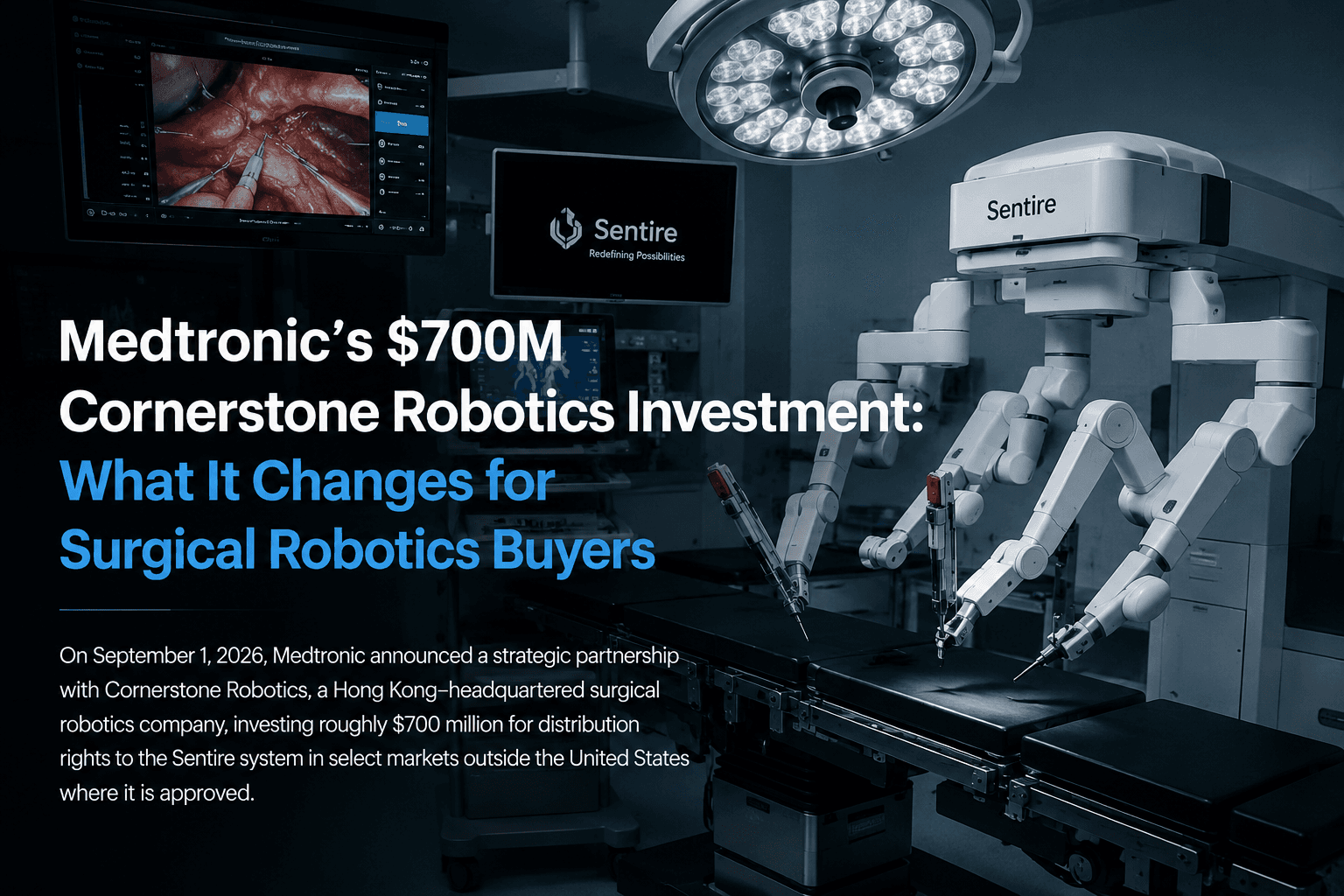
On September 1, 2026, Medtronic announced a strategic partnership with Cornerstone Robotics, a Hong Kong–headquartered surgical robotics company, investing roughly $700 million for distribution rights to the Sentire system in select markets outside the United States where it is approved 1. This is not an acquisition — it is a distribution play for the next generation of minimally invasive surgery. For procurement teams planning 2026–2027 surgical equipment budgets, three questions matter more than the headline: why now, what approvals a robot actually needs to reach your operating room, and what the real cost of ownership looks like.
Why Medtronic Is Putting $700 Million Behind Surgical Robotics — Penetration Is Still in Single Digits
What the $700 Million Actually Buys
The heart of the deal is not "buying the company" — it is gaining the right to sell Sentire. Medtronic can distribute the system in specified non-U.S. markets alongside its own Hugo system 1. Cornerstone keeps product development and manufacturing; Medtronic brings the channel and the global service network. It is a classic product-for-channel structure: lower risk than an outright acquisition, but a looser bond between the two companies.
Why Carry a Second Platform Instead of Going All-In on Hugo
Hugo is not standing still. It is already used in more than 35 countries across six continents, received FDA clearance within the past year, and is growing at more than twice the rate of the overall robotic surgery market 2. The problem is that global penetration of robotic-assisted surgery is still in the single digits 3 — one platform alone cannot cover a market this early. Adding Sentire gives Medtronic two systems at different price points and different surgical workflows, aimed at different tiers of hospitals. That is the logic behind a "dual-platform" strategy.
💡 Expert Insight: The hard part of a two-platform strategy is rarely the product — it is the sales channel. The same team has to know when to position Hugo and when to position Sentire. For buyers, this is usually good news: more options and more room to negotiate.
What Single-Digit Penetration Means for You
Single-digit penetration is one of the most valuable signals in equipment procurement. It means the technology direction has been validated, but most hospitals have not entered yet. Looking at the history of imaging equipment, this is typically the window where supply-side structures get reshaped — divestitures, consolidation, and alliances tend to cluster within a few years.
Who Is Cornerstone's Sentire — a Surgical Robot Out of Hong Kong
The Hardware: Multi-Port, Dual-Console
Sentire is a multi-port platform developed entirely in-house by Cornerstone, with an immersive surgeon console that supports dual-console operation — two surgeons can control the system on one case 4. The dual-console design matters most in teaching hospitals: the lead surgeon can operate and train at the same time, which is a real advantage when building a robotic surgery team.
A Regulatory Footprint Built Market by Market: NMPA → Singapore → CE
Sentire's approval path is a useful case study for buyers who want to see what "qualified to sell" actually looks like:
- NMPA approval in China (2024) 4
- Singapore approval 4
- CE Mark in May 2026, covering general, gynecologic, thoracic, and urologic procedures 4
Each approval adds clinical data and a denser service network.
The Regulatory Gate: What CE, FDA, and NMPA Each Actually Control
For a buyer, "this robot has been approved" and "this robot can land in your market" are two different statements. The three mainstream approval regimes do very different jobs:
Approval is regional. Sentire holds CE, NMPA, and Singapore approval, but it is not currently sellable in every market — which is exactly why the Medtronic distribution agreement is limited to "select approved markets." When your team checks whether a system can be bought and serviced, check the approval coverage first, then the supplier's service capability.
Beyond da Vinci: The Second Tier Is Forming
The global surgical robotics market has long been dominated by Intuitive Surgical's da Vinci platform. With Medtronic entering on a dual-platform basis, and local players in several regions, the market is moving from "one dominant platform" toward a multi-platform second tier.
What a Multi-Platform Market Changes for You
The practical effect for buyers is simple: you now have more quotes to compare against. In a single-vendor frame, negotiation happens inside one company's price structure. With a second tier forming, hospitals gain a horizontal reference across function, price, and service contracts. More structural change is usually good for a hospital's bargaining position — but more options also means more screening work. The most direct way to cut that screening cost is to put supply and suppliers on the same table. If you are planning surgical equipment purchases, search surgical equipment and send inquiries on MedTrade to compare multiple suppliers' quotes and credentials side by side.
⚠️ Watch Out: This article describes market structure, not a prediction of winners. Every player has a different regulatory path, channel strength, and clinical data record — treating "the landscape is shifting" as "this vendor will win" is one of the most common mistakes in procurement.
Robotic-Assisted Surgery vs. Traditional Laparoscopy: When It Is Worth It
The most common question a procurement team faces: does your department actually need a robot? The answer is not "yes or no" — it is "it depends." The two systems serve different procedures and call for different decision frameworks:
You can collapse this into three questions: Does your case volume support the utilization rate? Does the team have enough surgical volume to absorb the learning curve? Does the budget cover the dedicated instruments and service contract on top of the system? Only if all three answer "yes" does a robot deserve a serious business case.
How Much Does a Surgical Robot Cost? The Full Cost of Ownership
Robot pricing is often compressed into a single "system price," but the real cost stacks three layers:
(Note: quoted prices vary widely by vendor and configuration, so we do not publish estimates here — ask suppliers to itemize all three layers in writing before comparing.)
We have covered the trap of service contracts in our analysis of predictive maintenance, downtime economics, and EaaS: many teams budget only the system price and treat the service contract as an optional extra — yet that line item decides how long the equipment lasts and how long a failure takes you offline.
Why the "Used Robot" Shortcut Is Not What It Looks Like
The refurbished market for conventional imaging equipment is mature. Surgical robots are the exception. The reason is the tight coupling between approval and service: market access hangs on the specific vendor and product, so a refurbished unit faces approval, instrument compatibility, and service authorization questions all over again — a much higher bar than a used ultrasound or CT. The instinct that "a used robot saves money" largely does not hold in RAS. To see the refurbished-vs-new decision framework applied to MRI and CT, start with our refurbished vs. new ROI buying guide, then adjust it for the robotics case.
The Deep Dive: Questions to Ask Before You Buy Any Surgical Robot
A Market-Access Checklist
Before you accept any robotic system quote, verify every line below — then talk price:
The Reality of Service Ecosystems — and the Path When Budget Can't Stretch
The other reality of surgical robots: buying one is not the same as keeping one. Training, instruments, and maintenance are ongoing costs. Many departments finish the assessment and find the right near-term move is not a robot at all — it is upgrading the conventional surgical equipment and standardizing laparoscopy capability first. That category has a much lower entry bar, a much shorter delivery cycle, and a far more mature service ecosystem — and it happens to be the category you can put out for inquiry online today.
If your department is in the "we want a robot, but the budget and the team are not there yet" phase, the practical first step is to map the supply and suppliers of conventional surgical equipment — electrosurgical units, endoscopes, laparoscopy instruments and the like — before committing to a capital plan. Search surgical equipment and send inquiries on MedTrade, and put multiple vendors' quotes and credentials on the same table. It is a faster, cheaper way to build the baseline your robot business case will eventually need anyway.