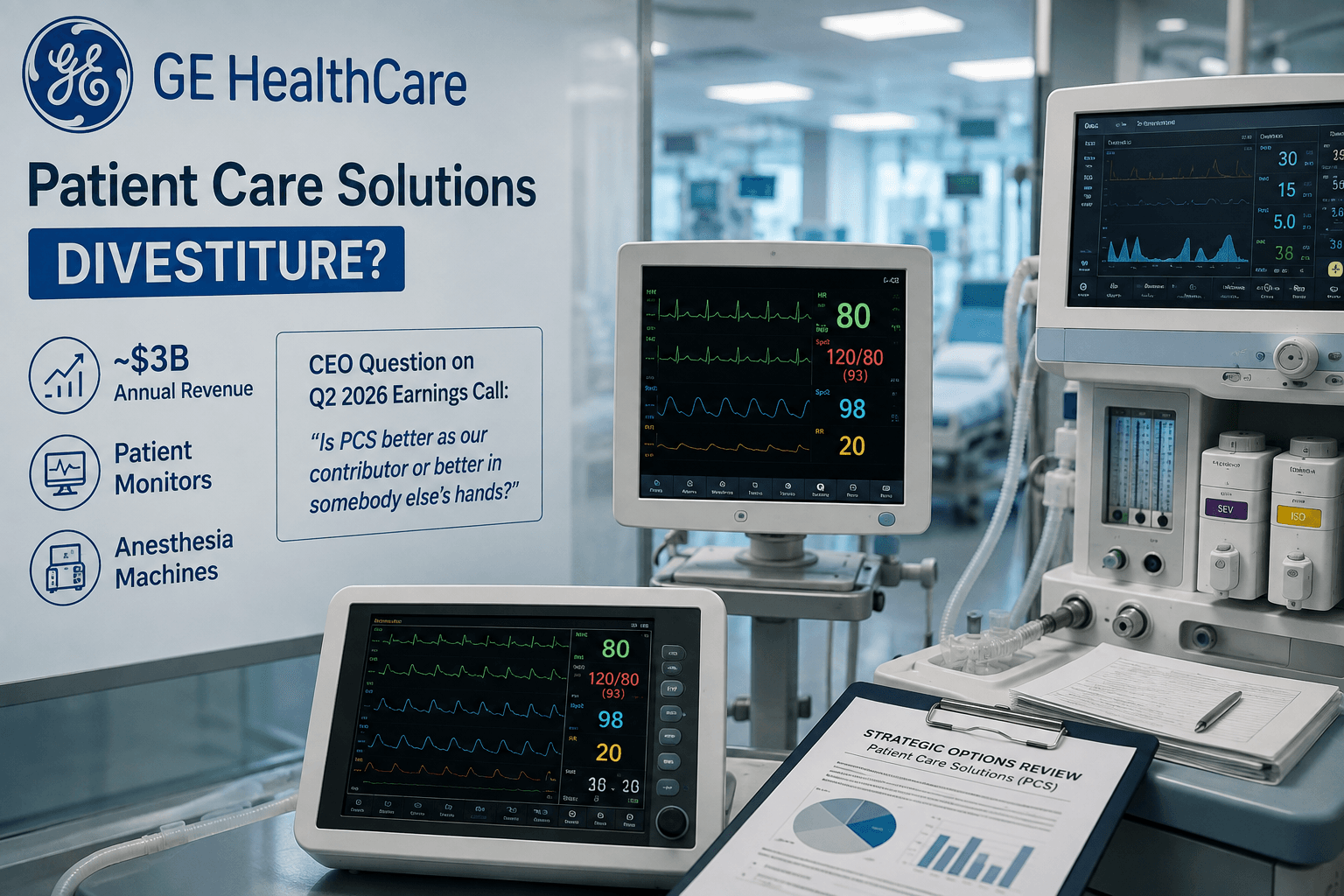
On July 29, GE HealthCare's second-quarter 2026 earnings call surfaced a question few had seen coming: is Patient Care Solutions (PCS) — the unit behind the company's patient monitors and anesthesia machines — "better as our contributor or better in somebody else's hands?" With that single line, CEO Peter Arduini put a business worth roughly $3 billion a year on the table for a possible divestiture.
Why GE HealthCare Put PCS Under Review — the Q2 Numbers
The quarter's numbers were rough
PCS was the biggest drag on an otherwise solid quarter. From the company's official earnings release1:
Segment EBIT — a single business unit's earnings before interest and taxes — turning negative means the segment isn't just slowing; it's losing money at the operating level.
Supply shortages stalled deliveries while orders grew
Arduini pointed to "operational delivery challenges" on the call: shortages of certain key components meant the company couldn't complete deliveries, and some orders slipped into the second half. The striking counter-signal: PCS orders were still growing, with the monitoring business reaching its highest order level in months2. That's a book-to-bill ratio above one — demand is there; supply is the bottleneck.
From four segments to three
The review didn't happen in isolation. In April 2026, GE HealthCare merged its Imaging and Advanced Visualization Solutions (AVS) businesses into Advanced Imaging Solutions (AIS), cutting its reporting segments from four to three: AIS, Pharmaceutical Diagnostics (PDx), and PCS. Company-wide, Q2 was actually healthy — total revenue of $5.30B, up 5.7%, with adjusted EPS of $1.131 — so the problem is concentrated in this one unit.
How Big Is PCS — a $3 Billion Business, Broken Down
Monitoring plus life support
PCS isn't one product; it's two product lines plus a layer of consumables, services, and digital offerings. Per GE HealthCare's 10-K segment data3, fiscal 2025:
Life Support — anesthesia and ventilation machines — has been declining and is the main reason PCS overall shrank.
What 15% means
At about $3 billion a year, PCS is roughly 15% of GE HealthCare's total revenue (~$20.6B). Divesting it would remove a 15% revenue slice from the books — but also a segment that's been flat-to-declining and is now losing money. For investors, that reads as shedding weight, not bleeding revenue.
Keep It, Sell It, or Something Else — the Logic of Three Options
"Doing less" is the theme
Since spinning off, GE HealthCare has been systematically doing less — narrowing toward high-margin, high-barrier imaging and diagnostics. Patient monitoring is a flatter-growth, more crowded market, so freeing up capital to reinvest in higher-return categories is a straightforward capital-allocation move.
Cash now vs. recovery later
The company's confirmed options are three: continued ownership, a sale, or other value-enhancing transactions1.
One of the dimensions Arduini flagged on the call was SG&A — selling, general and administrative costs — and whether the business's geographic reach and cost structure ultimately fit. That line of questioning ends at the extreme option: is this business simply better off in someone else's hands?
If It Changes Hands, What Actually Moves — the Buyer's Blind Spot
Most financial coverage stops at "sell or don't sell." The part that matters to equipment buyers and used-equipment dealers is what happens next.
Will support for in-service GE monitors change?
Whatever the outcome — sale or otherwise — the first question for a buyer isn't "who takes over," it's whether aftermarket support for equipment already in the field changes. Patient monitors often run 7–10 years in a hospital, and parts, repair, and software updates form a long tail of aftermarket revenue. If the unit changes hands, whether the service network transfers cleanly will directly shape the maintenance cost of a large installed base. For the full logic on equipment lifecycle cost and the price of downtime, see our guide to predictive maintenance and downtime economics.
⚠️ Watch Out: A strategic review is not a sale. So far this is "under review / considering" — no transaction has closed. Don't treat the rumor as a done deal, and don't swap out suppliers preemptively. Wait for an official statement on service continuity.
What to expect on price and supply
Structurally, global patient monitoring is dominated by a handful of top players, who together hold roughly 90% of the market (industry research estimates — figures vary by report and definition)4. If a $3 billion business changes hands, the near-term outcome is unlikely to be a price collapse; it's more likely a reshuffling of supply and service networks — exactly the window used-equipment dealers and distributors should be watching.
What Buyers and Dealers Can Do Now — Signals and a Checklist
Three signals to watch
- Service continuity announcements — whether GE HealthCare or a prospective buyer commits to parts, service, and software support for the installed base.
- Delivery and supply — whether PCS actually delivers its promised "shipment acceleration" in the second half; that determines near-term supply relief.
- Pricing and inventory — used-market pricing in the monitoring category often moves ahead of official actions.
If you're weighing a used imaging or monitoring purchase, the full new-vs-refurbished ROI comparison is in our refurbished vs. new buying guide.
Turn the news into a search
Whichever side you're on — hospital biomedical engineering, a used-equipment dealer, or an independent service organization — the practical move is the same: look at real supply, not headlines. MedTrade's monitoring category lists GE and other brands with suppliers ready to take inquiries. Search patient monitoring equipment (GE) or browse the supplier directory, and turn "is GE selling?" into "what can I buy, and who can I reach?"