
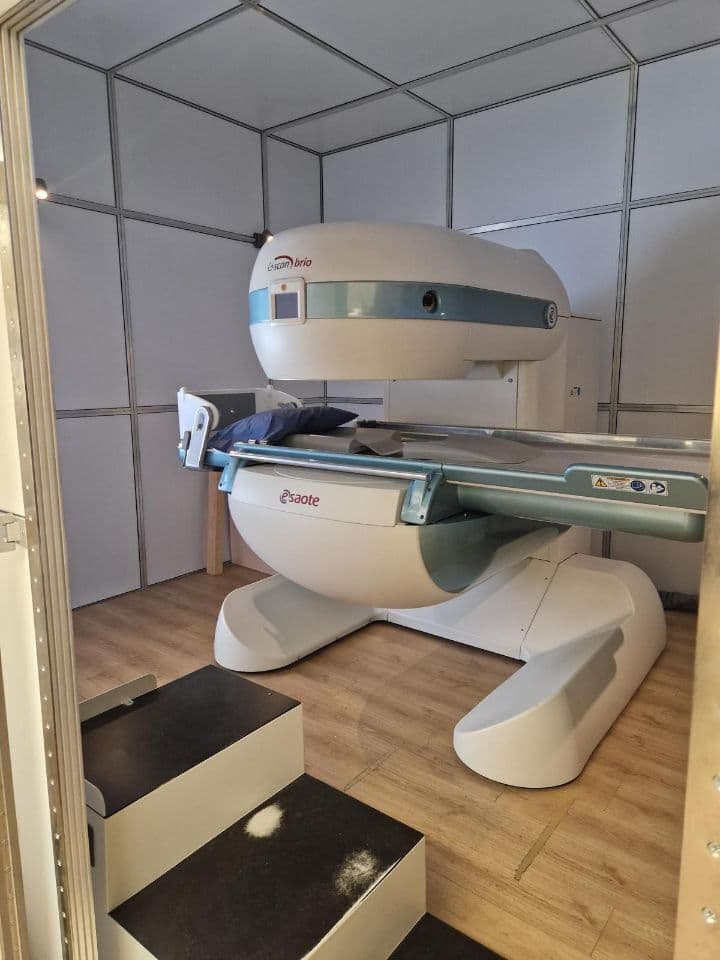
ESAOTE S-scan MSK MRI | 2017 | SW Platform E-MRI Brio | Evolution 16.2 | Permanent Magnet 0.25T

Public supplier signals are visible here. Send an inquiry when the listing looks commercially fit.
Product Details
Product Overview This is a professionally maintained 2017 ESAOTE S-scan, featuring the MRI Evolution 16.2 enhancement package. Built on the reliable E-MRI Brio software platform (Version 5.02), this dedicated MSK system offers high-quality imaging for spine and joint diagnostics without the high overhead of superconducting magnets. It meets all original OEM Specifications and is ready for clinical re-deployment.
Technical Specifications
| Field | Specification |
| Manufacturer | ESAOTE |
| Model / Type | S-scan (Dedicated MSK MRI) |
| DOM / Year | 2017 |
| Software Platform | E-MRI Brio (Version 5.02) |
| Upgrade Level | MRI Evolution 16.2 |
| Magnet Type | 0.25T Permanent Magnet (Cryogen-Free) |
| Condition | Sourced from a working clinical environment / Fully Tested |
Included Coil Suite (Full MSK Inventory)
- Spine Array Coil (Comprehensive Cervical/Lumbar coverage)
- Shoulder Coil
- Knee Coil
- Hand/Wrist Coil
- Foot/Ankle Coil
- Multi-purpose Flexible Coils
Quality & Condition
- Evolution 16.2 Features: Improved image reconstruction algorithms and optimized pulse sequences for MSK.
- Magnet Stability: Permanent magnet design ensures excellent uptime and zero liquid helium (LHe) costs.
- Workflow: E-MRI Brio interface provides an intuitive and fast patient throughput environment.
- Physical Status: Clean housing, no cosmetic damage, and all cables verified for signal integrity.
More from Pro Imaging
More in MRI Scanner
Related editorial coverage
Ultrasound Transducer Common Failure Modes: How to Diagnose, Repair, or Replace
Ultrasound probe image problems? Diagnose lens delamination, oil leaks, cable damage & element dropout. Repair vs replace framework + find repair services on MedTrade.
AI Medical Imaging 2026: What the Clinical Data Actually Says
A data-driven look at AI radiology in 2026: the largest RCT ever conducted, why models crash across populations, and the ROI gap no one talks about.