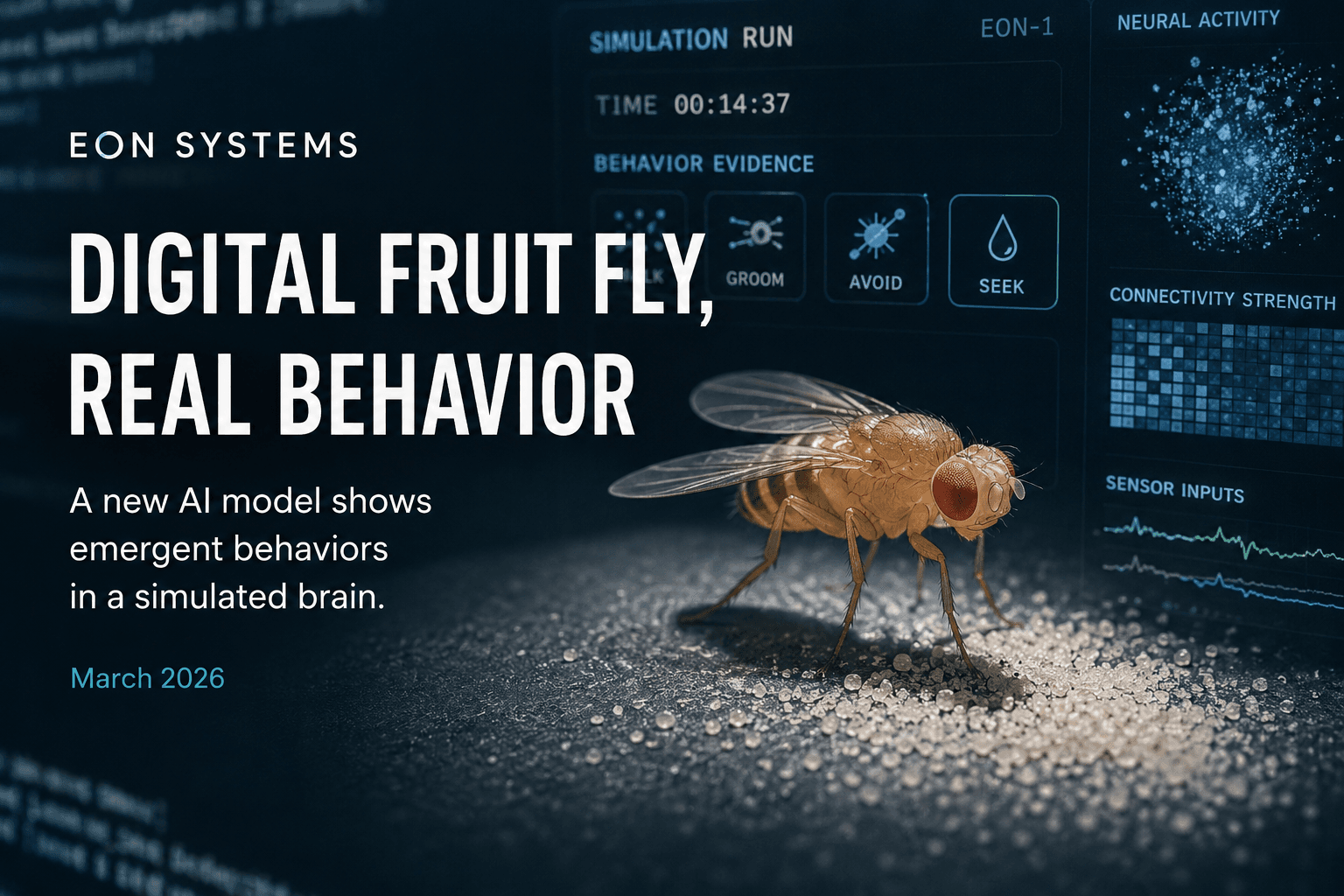
In March 2026, a San Francisco startup called Eon Systems released a demonstration video that jolted two communities at once — computational neuroscience and artificial intelligence. A digital fruit fly, never programmed with a single line of behavioral code, walked across a virtual sandbox. It groomed its antennae when dust landed on them. It fled from expanding dark shapes mimicking approaching predators. It sought out sugar 1.
What powered it was not a reinforcement-learning reward function. Not a large language model's parameter extrapolation. It was a physical wiring diagram — 125,000 neurons and roughly 50 million synaptic connections — copied synapse by synapse from a real adult fruit fly brain, then plugged into a physics-constrained virtual body running a 15-millisecond closed loop 2.
This was not another "AI learned a new trick" announcement. A group of engineers and neuroscientists were trying to answer a more fundamental question: if intelligence lives not in the algorithm but in the structure — if you copy a brain's physical wiring diagram into a computer exactly as nature built it — does it, in some sense, come alive on its own?
The Blueprint — How FlyWire Reverse-Engineered a Brain at Nanometer Resolution
Before we get to the computation, we need to understand where the hardware blueprint came from.
The digital fly's foundation rests on data from the FlyWire Consortium — a massive neuro-mapping effort led by Princeton neuroscientist Mala Murthy and computational scientist Sebastian Seung, spanning 122 institutions and 146 laboratories worldwide 3. In 2018, the Howard Hughes Medical Institute's Janelia Research Campus sectioned an adult female Drosophila melanogaster brain and imaged it with nanometer-scale electron microscopy at a resolution of 4 × 4 × 40 nanometers per voxel — fine enough to resolve individual chemical synapses and the sub-micron branching of axons and dendrites 4.
💡 Expert Insight: Before the adult fruit fly, science had fully mapped the connectomes of exactly two organisms: C. elegans (302 neurons) and the fruit fly larva (roughly 3,000 neurons). The adult fly's 140,000-neuron network is nearly 500 times larger than the worm's. That is why, when FlyWire published its results in 2024 as a nine-paper package in Nature, the field treated it as the moment connectomics graduated from toy models to meaningful complexity 5.
Raw electron micrographs are only the starting point. Turning two-dimensional slices into a three-dimensional neural-wiring map is a data-engineering problem of staggering scale. FlyWire used AI image-segmentation algorithms developed in Sebastian Seung's lab to produce an initial 3D reconstruction — by one estimate, the AI saved roughly 50,000 human work-years of manual tracing 6. Even with that assistance, human scientists and citizen-science volunteers worldwide spent approximately 33 person-years on the final synapse-by-synapse proofreading, because the AI's error rate at fine neuronal branch points remained unacceptably high 5.
The resulting connectome specifies not only the spatial location of tens of millions of synapses, but for each connection: direction (which neuron is upstream, which downstream), weight (connection strength), and predicted neurotransmitter type — glutamate for excitation, GABA for inhibition, acetylcholine for modulation, and so on 3. This wiring diagram gave Eon Systems a deterministic scaffold for computational simulation. It was not a probabilistic guess. It was not a black-box approximation. It was a physical blueprint — ready to be populated with digital neurons.
Making the Blueprint Fire — LIF Neurons, 734-Parameter Vision, and the Art of Calculated Simplification
Once you have a wiring diagram, the next problem is: how do you make it conduct electricity?
In a real brain, neurons integrate and fire through intricate electrochemical dynamics — ion channels gating open and shut, dendrites performing nonlinear computations, action potentials racing down axons. A full compartmental conductance-based model simulating every one of these mechanisms for 140,000 neurons would overwhelm any GPU cluster in existence 2.
Eon Systems made a calculated trade-off between biological fidelity and engineering feasibility. They adopted the leaky integrate-and-fire (LIF) model — think of each LIF neuron as a leaky bucket. Upstream signals pour water into the bucket (membrane potential rises); water continuously leaks out through holes in the sides (potential decays toward rest). When the water level crosses a threshold, the bucket "fires" a spike to every downstream neuron and then resets to empty 7.
What is striking about this model is not what it includes but what it leaves out. The entire LIF network runs on one free parameter, α — a constant representing how much a single synaptic event changes the downstream neuron's membrane potential 7. No learning rate. No attention heads. No layer count. All of the network's information-processing capacity emerges from the physical topology of the FlyWire connectome. The engineers decide how fast the signal travels. Where it travels — and what happens when it gets there — is dictated entirely by biology's wiring diagram.
⚠️ Watch Out: This is not because Eon Systems' engineers did not want a more detailed model. LIF strips away the spatial morphology of real neurons, their dendritic nonlinearities, and the heterogeneity of ion-channel distributions. A dopamine neuron and a glutamate neuron in your brain fire in fundamentally different ways; in the LIF network, they are the same equation with different parameter values 2. This is an engineering compromise, not a law of nature.
The offline validation of the LIF model produced a number worth pausing on. Researchers used optogenetic tools (CsChrimson expressed via cell-type-specific split-GAL4 driver lines) to activate specific neurons in living fruit flies, then compared the digital model's predictions of downstream motor-neuron activity — specifically MN9, which controls proboscis extension during feeding. The match rate exceeded 90%7. Even stripped of nearly all biochemical detail, the connectome's topology alone captures roughly nine-tenths of the biological sensorimotor causal chain.
The visual pathway took a different technical approach. The fruit fly's optic lobe — retina, lamina, medulla, and associated structures — contains 64 distinct visual cell types. Modeling each one with full biological detail would blow up the parameter count. Eon Systems incorporated a deep mechanistic network (DMN) developed by Lappalainen and colleagues, which exploits a spatial-homogeneity assumption: local connectivity patterns are tiled periodically across a hexagonal lattice of 721 visual columns, compressing the entire visual pathway to just 734 free parameters2. This visual sub-network was trained end-to-end on the Sintel natural-video database using PyTorch for optical-flow extraction, and its output feeds directly into the central LIF network as a structured sensory stream 2. (For a parallel perspective on how deep learning is actually performing in clinical radiology today — the "black box" approach these brain-emulation researchers are explicitly departing from — see our analysis of AI medical imaging in 2026.)
Closing the Loop — How NeuroMechFly v2 Gave a Simulated Brain a Body
For decades, computational neuroscience has built "brains in a vat" — models that generate neural spikes but have nowhere to send them and no way to receive behavioral feedback from an environment 8. Eon Systems closed this gap by building what is, to our knowledge, the first closed-loop embodied system operating on a whole-brain connectome.
The body came from NeuroMechFly v2, a framework developed by the neuroengineering group at EPFL (École Polytechnique Fédérale de Lausanne) 2. Running on the MuJoCo physics engine, it reconstructs the fruit fly's 3D anatomical mesh from high-resolution X-ray micro-tomography and equips it with 87 independently actuated mechanical joints — each constrained by contact forces, friction, and gravity 2.
The entire system runs a 15-millisecond closed control loop 2:
The significance of this loop is hard to overstate. A traditional AI agent — say, a reinforcement-learning policy — perceives the world indirectly through a reward function. It does not see the world; it sees a numerical evaluation of the world. The digital fruit fly's every sensory pathway has an anatomical origin. Every motor command traces back to the firing of a real population of neurons. It is not optimizing a function. It is, in a restricted but meaningful sense, just being.
No Code, No Training, Pure Emergence — When the Digital Fly Started Walking
Under this architecture, the digital fly produced the most striking result in the entire project: a suite of complex behaviors that were never scripted, never rewarded, and never trained — they emerged from the physical structure of the network itself. Unlike DeepMind's 2025 reinforcement-learning approach, which trained a virtual fly through explicit reward functions, Eon Systems' fly received no behavioral instruction whatsoever 8.
Three emergent behaviors have been characterized in detail through neural-circuit mapping 2:
Feeding response. When the virtual body's legs or proboscis contacted a sugar stimulus, gustatory receptor neurons (GRNs) carried excitatory signals into the brain, precisely triggering the feeding motor circuit pre-wired in the connectome, ultimately activating motor neuron MN9 — the cell that controls proboscis extension. Bitter compounds, routed through inhibitory synapses, shut down the same circuit. Approach sweet, avoid bitter: not a programmer's if-else, but the physical consequence of synaptic polarity.
Antenna grooming. Real fruit flies groom their antennae with their front legs to keep their mechanosensory and olfactory surfaces clean. In simulation, when "virtual dust" stimulated the mechanosensory neurons of Johnston's organ at the base of the antenna, the electrical signal traveled along the sensory pathway and naturally activated specific grooming command neurons. The virtual body stopped walking, raised a foreleg, and executed a coordinated wiping sequence — the same circuit real flies use 2.
Fleeing and foraging. When the visual field contained a rapidly expanding dark disc — the signature of an approaching predator — the visual network not only detected the optic-flow anomaly but significantly activated escape-eliciting circuits in the central brain. Simultaneously, in an odor-guided foraging task, the system spontaneously compared olfactory-gradient differences between its left and right sensors to output turning commands that steered it toward the source 2.
💡 Expert Insight: Researchers are excited about these behaviors not because fruit flies can do them — real flies obviously can — but because nobody told the digital fly to do them. A brain shaped by hundreds of millions of years of evolution encodes its own "pre-training": the topology of its neurons and the distribution of its synapses are, in effect, an extreme compression algorithm for survival-relevant sensorimotor mappings 9. Modern deep learning — the Transformer and its variants — is a "black box" mimic that depends on enormous compute budgets and hallucinates on out-of-distribution inputs. Whole-brain emulation opens a "white box" alternative: every neuron's activation path has a traceable anatomical meaning 10.
"We Haven't Uploaded a Fly" — Three Hard Problems the Critics Are Right About
While the demonstration video generated excitement across the tech press, the neuroscience community subjected the project to intense scrutiny. The most trenchant critique came from the LessWrong community in a detailed technical analysis whose title says it plainly: "No, We Haven't Uploaded a Fly Yet"11.
Three structural problems form the core of the critique:
Problem 1: The missing VNC and the pre-programmed "back door." In a real fruit fly, the brain's descending motor commands do not directly control muscles. They must first pass through the ventral nerve cord (VNC) — the fly's equivalent of a spinal cord — containing roughly 15,000 neurons that compute the hexapod gait coordination and joint-level torque control required for walking 2. Eon Systems' current model does not include a VNC connectome. Instead, the engineers hand-picked a small set of descending neurons — DNa01 and DNa02 for turning, oDN1 for forward velocity — and hard-coded their output to a walking controller that had been pre-trained via imitation learning on the NeuroMechFly body 2. Critics argue, with some justification, that the digital fly did not learn to walk; it triggered a pre-rendered animation at the right moments. This manual wiring substantially weakens the claim of "pure biological upload"11.
Problem 2: Missing dynamic signatures. The fruit fly's ellipsoid body — a structure in the central complex — contains a ring-attractor network. When a real fly turns in space, a localized "bump" of neural activity moves continuously around this ring, functioning as the fly's internal compass for spatial orientation 11. If Eon Systems had truly achieved a 1:1 brain replication, this signature dynamic should appear spontaneously in the internal data. It has not been shown.
Problem 3: Absent chemistry and frozen plasticity. The LIF model omits the spatial morphology of real neurons, their dendritic nonlinearities, and their ion-channel diversity. More critically, the simulation entirely lacks the internal chemical states that govern real behavior — hunger and satiety, mating drive, hormonal fluctuations — as well as the diffusely projecting neuromodulators (dopamine, serotonin, octopamine) that shape global brain states 2. The absence of short-term synaptic plasticity means something more stark: this digital fly cannot learn anything. It is frozen at the microsecond its connectome was fixed by electron microscopy.
From Fly to Human — The Roadmap and What It Means for Neuro-Medical Devices
Eon Systems has publicly stated that its next target is the mouse brain — roughly 70 million neurons, approximately 560 times more complex than the fruit fly 1. Beyond that lies the human brain: about 86 billion neurons and trillions of synapses, roughly 700,000 times the fly's scale 10.
For the neuro-medical device industry, this trajectory carries implications that are closer to the engineering roadmap than they first appear. Three specific pathways are already visible in outline:
-
Functional neuroimaging validation. Whole-brain emulation models can serve as high-fidelity ground-truth references for calibrating and validating fMRI functional-connectivity analyses and EEG source-localization algorithms. Today, these techniques are validated against post-operative histology or invasive electrode recordings — methods that are expensive, sparse, and ethically constrained. A validated computational reference brain could dramatically accelerate the development cycle for next-generation neuroimaging analysis pipelines.
-
Neuromodulation target optimization. Deep brain stimulation (DBS) and transcranial magnetic stimulation (TMS) currently select targets based on population-averaged brain atlases. Patient-specific whole-brain models — even at reduced biophysical resolution — could enable pre-operative simulation of how different stimulation parameters affect specific circuit dynamics. Research groups are already exploring individualized connectome-based modeling for epilepsy surgery planning; whole-brain emulation extends this logic to the full brain 11.
-
Brain-computer interface decoder calibration. Invasive BCI systems today require extensive per-patient calibration data to train neural decoders. Simulation-driven neural-encoding models offer a path to injecting a "universal neural-coding prior" into the decoder, substantially reducing per-patient calibration time — a prerequisite for moving BCIs from laboratory demonstrations to clinical deployment at scale.
What ties these threads together is a common directional shift: neuroimaging and neuromodulation devices are moving from seeing structure toward simulating function. And the hardware supply side of that transition — MRI systems, EEG platforms, and the service infrastructure around them — is already live on platforms like MedTrade. If you are evaluating or procuring neuroimaging equipment, you can browse MRI systems from global suppliers on MedTrade and send inquiries directly. For a look at the non-invasive neuromodulation technologies already transforming stroke rehabilitation and chronic pain treatment — the clinical reality today, while whole-brain emulation works toward tomorrow — see our analysis of the current neuromodulation landscape.
As for the larger philosophical question — whether whole-brain emulation leads toward what some have called "digital immortality" — that debate is publicly discussed on Eon Systems' own careers page 12 and vigorously contested in communities like LessWrong 11. Functionalist philosophy of mind holds that consciousness is not a mysterious property of carbon-based molecules but an emergent result of specific information-processing dynamics. If those dynamics — mediated by synaptic connectivity — can be reproduced with sufficient fidelity on a silicon substrate, the digital substrate would generate continuous consciousness and subjective experience 11. But long before any such prospect arrives, a digital fly that cannot learn, has no emotions, and walks on a pre-trained gait controller has already done something worth noticing: it has forced us to ask what, exactly, we mean by the word "intelligence."