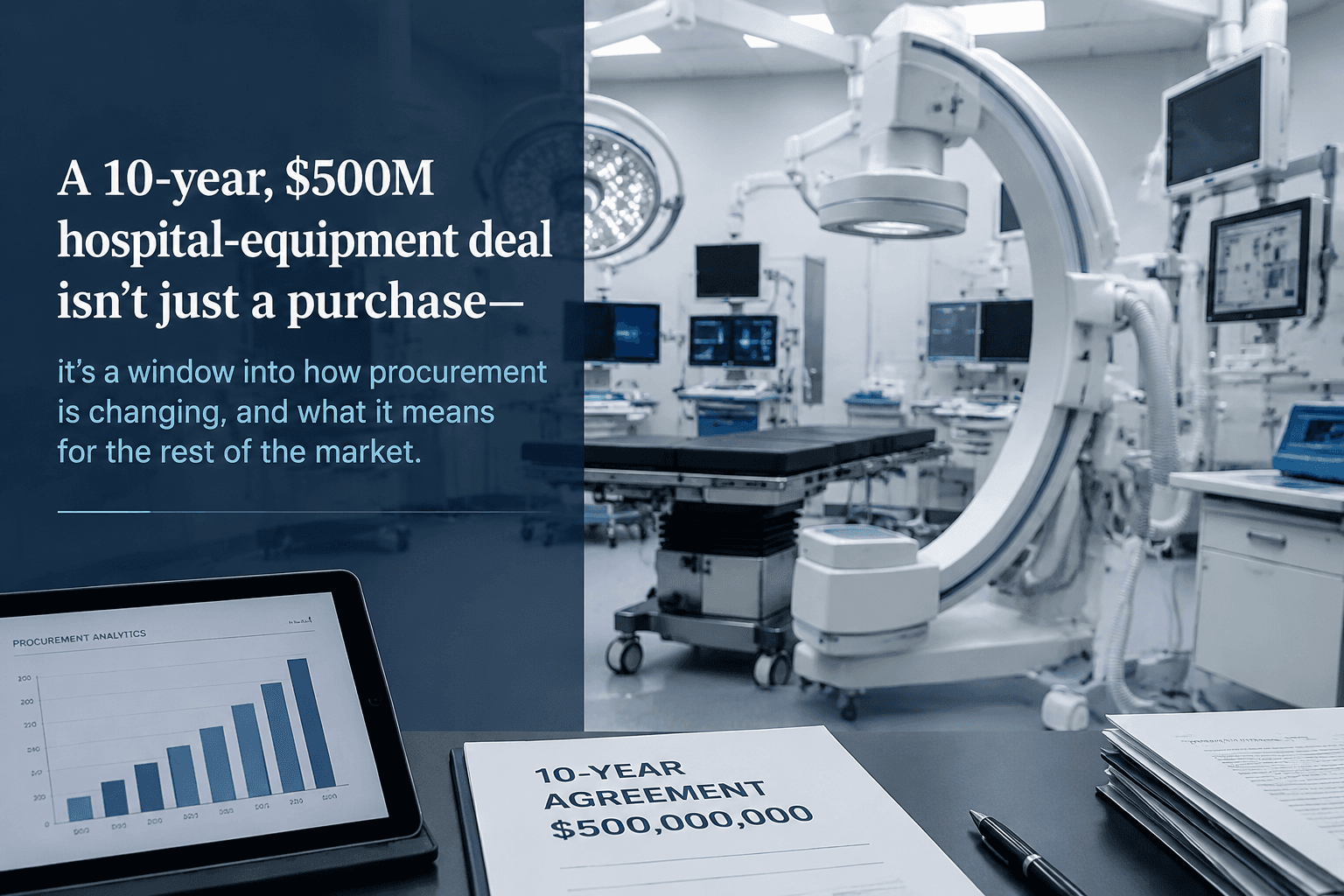
On July 16, 2026, GE HealthCare and Catholic Health announced a 10-year strategic partnership valued at approximately $500 million. The headline numbers are easy to recite: 1,300+ pieces of technology across 40+ clinical sites, spanning CT, PET/CT, MR, nuclear medicine, ultrasound, mammography, X-ray, surgery, anesthesia, diagnostic cardiology, and maternal-infant care.
If you're in the business of buying, selling, or servicing medical equipment, the instinct is to scan this as a big-ticket purchase order. Don't. This isn't a procurement event. It's a procurement model — one that tells you more about where the equipment market is headed than any industry report published this year.
Here's what's actually in the deal, what it signals, and why it matters even if you'll never sign a nine-figure contract.
$500 Million Buys What, Exactly? Breaking Down a Care Alliance
The numbers don't divide neatly. $500 million ÷ 1,300 devices ≠ $385,000 per machine. A Care Alliance — GE HealthCare's term for these long-term, bundled partnerships — is structured differently from a traditional equipment agreement.
The equipment is only part of the bill — possibly not even the largest part
Catholic Health is getting imaging hardware across virtually every modality. But three non-equipment line items likely account for a substantial share of the $500 million:
1. A 10-year multivendor service agreement. The release is explicit: this covers "comprehensive imaging, biomedical maintenance, and service support" including "lifecycle and fleet management" across all 40+ sites. And it's multivendor — meaning GE HealthCare engineers will maintain equipment from other manufacturers sitting in Catholic Health facilities. A 10-year, multivendor service contract for 1,300+ devices across 40+ sites is not a warranty add-on. It's a standalone business line that may rival or exceed the hardware cost over the contract term.
2. AI, cloud, and software subscriptions. Imaging 360 — GE's cloud-based radiology operations platform — is named explicitly in the release, alongside "on-device AI solutions," "departmental and enterprise-level applications," and "digital solutions." These are not freeware bundled with a scanner purchase. They are per-seat or per-site SaaS products with annual recurring fees. Over 10 years, software costs compound.
3. An embedded cardiovascular scientist and system-wide training. The release mentions "an embedded cardiovascular scientist that can work directly with Catholic Health clinicians" and "comprehensive education and training." This is not a post-sale courtesy visit. It's a full-time expert embedded inside a client organization for years — a line item that, on its own, likely runs into seven figures annually.
Why "50% in the first three years" is the number to watch
The release states that approximately 50% of equipment additions will arrive during the first three years. This creates a distinct rhythm:
For anyone sourcing used medical equipment, 2026–2029 is the window to watch on Long Island.
Equipment-as-a-Service Is Eating Traditional Procurement — and It's Not Just for Giant Systems
The core of a Care Alliance is simple: Catholic Health isn't buying GE's machines. It's buying a guarantee that the machines will be available and working.
From CAPEX to OPEX: the financial logic, explained without the jargon
A traditional equipment purchase works like this: a hospital allocates a capital budget (CAPEX), buys a scanner outright, books it as a depreciating asset, and separately negotiates service contracts, software upgrades, and parts replacement — each requiring its own procurement cycle.
The Care Alliance model flips this. The hospital pays a predictable monthly or annual fee (OPEX — an operating expense). GE HealthCare commits to equipment uptime, continuous software updates, preventive maintenance, and parts replacement — all bundled in. The hospital's balance sheet shifts from a large depreciating asset and unpredictable repair costs to a flat, forecastable operating line.
For a system like Catholic Health — 17,000 employees, six acute-care hospitals, three nursing homes — the appeal is obvious: financial predictability, no separate capital approval for every device refresh, and one counterparty accountable for uptime across the entire fleet.
So what does a 200-bed community hospital do?
You don't have Catholic Health's leverage. No single vendor is going to build you a bespoke 10-year Care Alliance at the same per-unit economics.
But the underlying logic — buy uptime, not iron — is just as relevant. The path just looks different:
💡 Expert Insight: The refurbished equipment buyer is increasingly not the hospital that can't afford new. It's the operator that ran the numbers and realized the delta between a 5-year-old refurbished system and a new one buys five years of service contracts and a second modality. That math doesn't change when someone else signs a $500M deal — it gets validated by it.
1,300 New Machines Coming In = How Many Used Machines Coming Out?
The press release doesn't mention a single word about used equipment disposition. But 1,300 new devices don't materialize into occupied hospital space. For every new CT wheeled into a Catholic Health facility, an older one is wheeled out.
Mapping the replacement cascade
Catholic Health hasn't published a device-by-device retirement schedule. But using industry-standard lifecycle averages applied to the known deployment cadence gives a usable estimate:
- Ultrasound systems: Shortest lifecycle (5–7 years). With "hundreds" of new ultrasound units arriving, expect a fast, high-volume wave of used ultrasound hitting the secondary market between 2026 and 2028.
- CT scanners: 7–10 year lifecycle. The replaced CTs will likely be 16–64 slice systems — the core demand segment for community hospitals, independent imaging centers, and veterinary practices.
- MR systems: 10+ year lifecycle, smaller installed base. Fewer units, but each one is a high-value asset. Expect gradual MR availability peaking around 2029–2032.
- Maternal-infant care monitors: Batch-replaced during unit renovations. Smaller-ticket items with high secondary-market liquidity.
Long Island today, national supply tomorrow
Catholic Health's sites are concentrated on Long Island, New York. But the U.S. used medical equipment market is national. Dealers, auction platforms, and asset recovery firms move devices across state lines as a matter of routine. A concentrated replacement event in the Northeast ripples through inventory available to buyers in the Midwest, the South, and beyond.
⚠️ Watch Out: Replacement-wave pricing effects aren't uniform. High-demand modalities in good condition (e.g., a well-maintained GE 64-slice CT with low scan count) will move fast and hold value regardless of regional supply. The price softening hits harder on older-generation equipment and modalities where supply genuinely outstrips demand. If you're sourcing, know which tier you're targeting before you expect a discount.
For procurement planners at smaller hospitals and imaging centers: if a GE CT or ultrasound refresh is on your 2027–2029 roadmap, start tracking inventory flows out of the Northeast now. The units that Catholic Health replaces aren't junk — they're production machines being retired on a schedule, not because they failed.
The AI and Cloud Pieces Are Not Press-Release Filler — Here's What They Actually Do
"AI-powered" appears in roughly every medical device press release since 2023. This one names specific products. They're worth understanding, because they signal what buyers will be expected to pay for — and what sellers will need to support — over the next decade.
Imaging 360: a command center for radiology operations, not a diagnostic tool
Imaging 360 is often grouped under "AI" in marketing language. But its functions are operational, not clinical:
- Unified workflows across sites. Instead of each of 40+ locations running its own radiology information system with manual cross-site reconciliation, Imaging 360 provides a single workflow layer. Scheduling, report assignment, and image routing operate across the entire system.
- Centralized performance visibility. A system-wide dashboard shows device utilization rates, exam wait times, and report turnaround by site. A radiology director can see that St. Francis Hospital's MRI has a 3-day wait while St. Joseph Hospital's scanner sits at 40% utilization — and rebalance.
- Remote scanning support. An expert technologist at one site can guide scan parameter adjustments at another in real time. In a market where radiologic technologists are in short supply, this isn't a convenience feature — it's a workforce multiplier.
For anyone managing multiple imaging sites: Imaging 360 is the kind of tool that turns "we have eight scanners across four locations" into "we have one imaging network." The value isn't AI magic. It's visibility.
Flyrcado: why a single PET tracer got its own paragraph
Flyrcado (flurpiridaz F 18) is GE HealthCare's proprietary PET myocardial perfusion imaging agent. It uses fluorine-18 labeling with a 109-minute half-life — long enough that a patient can be injected at peak exercise (running on a treadmill until target heart rate, then injected, then scanned), something that isn't practical with shorter-lived tracers.
In April 2025, Catholic Health's St. Francis Hospital & Heart Center became the first U.S. site to perform an exercise-stress PET MPI study using Flyrcado. That's a clinically meaningful milestone in cardiology — it opens a diagnostic pathway (exercise stress + PET + dedicated tracer) that was previously logistically constrained.
⚠️ Medical Disclaimer: This article does not constitute medical device advertising. Flyrcado safety information and indications are governed by the current FDA label. Specific diagnostic or treatment decisions should be made in consultation with a licensed physician. For full prescribing information, refer to the FDA label.
The three-tier AI architecture: it matters who signs the check
The release distinguishes between on-device AI (e.g., automated scan positioning and dose optimization built into a CT scanner), departmental AI (e.g., workflow scheduling across a radiology department), and enterprise AI (e.g., predictive maintenance and cross-department resource orchestration).
This isn't a marketing taxonomy. Each tier maps to a different buyer within a hospital:
If you sell or service medical equipment, pay attention to tier two and three. They represent recurring software revenue that sits on top of the hardware sale — and they're the reason a $500 million deal isn't just a hardware order.
Big Systems Pool Buying Power. Here's How Smaller Buyers Respond.
When Catholic Health negotiates hundreds of GE devices in one contract, the per-unit leverage is orders of magnitude beyond what a single-site buyer can command. That's the reality. The question is what you do with it.
Three levers that don't require a $500M checkbook
Lever one: Procurement timing. When a large system floods the secondary market with retired devices, supply-side pricing shifts — particularly for mid-tier modalities. A refurbished GE CT that cost a dealer $X to acquire in 2025 may cost less in 2028 if Northeast supply is running high. If your replacement cycle is flexible, timing the market is a legitimate cost lever.
Lever two: Model selection. The newest-generation scanner carries a launch premium that has nothing to do with clinical utility. A previous-generation flagship — refurbished, calibrated, and covered by an ISO service contract — produces diagnostic images that, for the vast majority of routine clinical scans, are indistinguishable from the latest model. The difference is on the invoice, not the PACS screen.
Lever three: Service independence. An OEM service contract for a CT scanner typically runs 8–12% of the device's replacement value per year. An independent service organization (ISO) contract for the same device often runs 4–7%. Over a 10-year lifecycle, that gap alone can exceed the cost of a second refurbished modality. The trade-off: you need a reliable parts supply chain — and that's where having access to a global supplier directory with verified seller credentials and structured, verifiable repair histories changes the equation.
The buyer profile is shifting — and it's not about budget desperation
An independent imaging center that buys a refurbished GE 64-slice CT for $150,000–$250,000 (equipment + install + first-year service) instead of a new equivalent at $400,000–$600,000 didn't settle. They allocated the $250,000–$350,000 difference to other things — staffing, marketing, an additional ultrasound unit, or simply a faster path to breakeven. The patient pays the same for the scan either way. Reimbursement codes don't distinguish "new" from "refurbished."
This is why the old narrative — "refurbished is for hospitals that can't afford new" — is collapsing under its own weight. The math is the math, and more buyers are doing it.
💡 Expert Insight: In our conversations with procurement managers at independent imaging centers and veterinary hospitals, the most common reason for choosing refurbished isn't "we had no choice." It's "we ran a 10-year total cost of ownership comparison and the refurbished path freed up capital for a second revenue-generating modality." When the ROI argument flips from defensive to offensive, the market has structurally changed.
Why the Service Bundle Is Worth More Than the Hardware — The 10-Year Math
This final section is for anyone who looked at the $500 million headline and thought "that's a lot of machines." It is. But the real story of this contract — and of the broader procurement shift it represents — is in the service line.
A 10-year TCO breakdown for a single MRI
Take a typical 1.5T MRI with an assumed new purchase price of $1,000,000:
The bottom line: over 10 years, non-equipment costs — service, parts, software, and downtime — account for roughly 60–65% of total cost of ownership. The million-dollar scanner is the entry ticket. The real spend happens in the decade after installation.
A Care Alliance doesn't make those costs disappear. It makes them predictable. For a hospital CFO, predictability beats discount almost every time — because the cost of an unbudgeted MRI outage (lost exams, rescheduled patients, overtime pay) is higher than the premium paid to guarantee it doesn't happen.
Multivendor service: the line in the release that should get your attention
Catholic Health doesn't run an all-GE fleet. No large health system does. The release specifies this is a multivendor service agreement — GE HealthCare engineers will maintain non-GE equipment across Catholic Health sites.
This matters because it breaks the traditional OEM lock-in model. When one of the largest OEMs publicly commits to servicing competitors' devices under a 10-year contract, "multivendor service" stops being a niche alternative and becomes a mainstream procurement requirement. Independent service organizations and parts suppliers should read this as a leading indicator: the multivendor trend is now being ratified at the top of the market, and the demand that large systems are creating will cascade down to smaller buyers who want the same flexibility without the same price tag.
What this means for dealers, ISOs, and parts suppliers
Care Alliances are built for the top tier — the 50 or so U.S. health systems large enough to negotiate nine-figure, decade-long contracts. The remaining 6,000+ hospitals, plus thousands of independent imaging centers, specialty clinics, and veterinary hospitals, have the same fundamental need — reduce the total cost of equipment ownership — but need to achieve it through a different combination:
- Refurbished equipment instead of new fleet purchases
- Independent service contracts instead of OEM Care Alliances
- Reliable, searchable parts supply instead of single-vendor lock-in
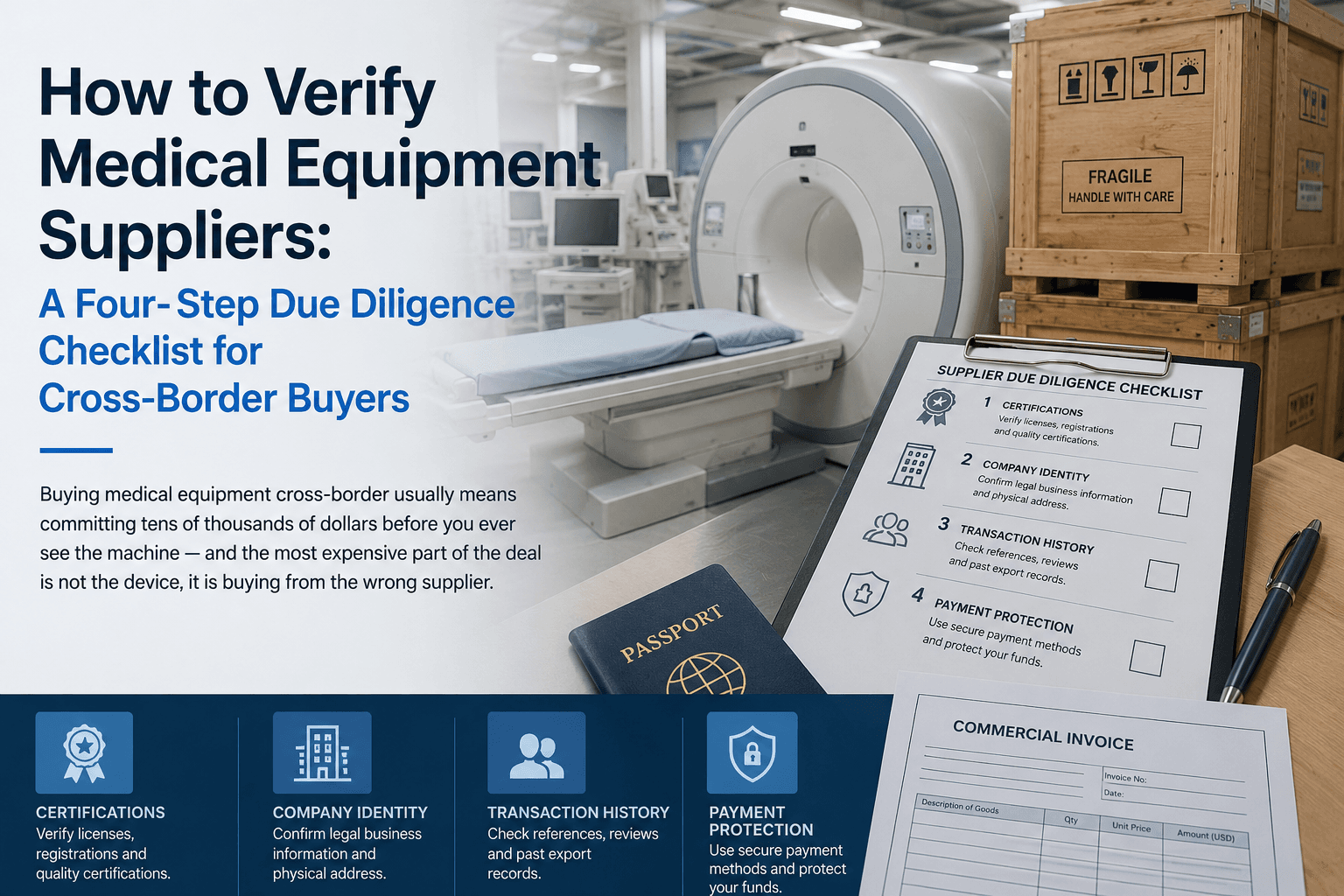
This is where a global supplier directory earns its place. A buyer evaluating a refurbished GE CT needs to verify the seller's credentials, cross-reference the model's known service history, and confirm that replacement parts and compatible service providers exist before committing. A structured repair report — not a forwarded PDF, but a public web page with a verifiable link tied to a confirmed supplier profile — turns "take the seller's word for it" into "here's what I can check before I wire a deposit."
What to Do With This Information
If you source equipment: the next 3–5 years will see elevated used-device supply flowing out of large-system replacement cycles — Catholic Health is one example of a broader trend, not an isolated event. Browse equipment listings to track the modalities and model years that match your procurement horizon. When supply rises, negotiating leverage shifts.
If you sell or service equipment: the multivendor, service-forward model is being institutionalized at the top of the market. Buyers who can't sign a Care Alliance will still want what it represents — predictable uptime, multi-brand support, and transparent equipment history. The more of that you can demonstrate — with structured data, not promises — the less you compete on price alone.
If you're just tracking where the industry is going: the $500 million number will get the headlines. But the real signal is in the quieter details — the multivendor clause, the embedded scientist, the 10-year service commitment that likely costs more than the hardware. The deal isn't about selling machines. It's about selling certainty. And that market is just getting started.
📚 Reference