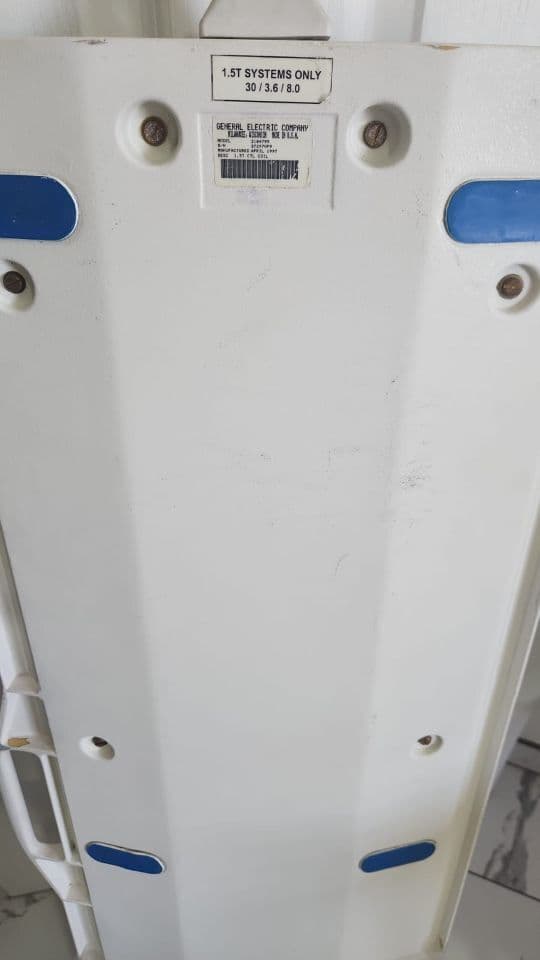
GE Eye/Ear Surface Holder MRI Coil

Public supplier signals are visible here. Send an inquiry when the listing looks commercially fit.
Product Details
The GE Eye/Ear Surface Holder Coil is a specialized MRI accessory designed to deliver high-resolution images of the orbital and auditory regions. Unlike larger, general-purpose coils, this surface coil is engineered specifically to provide the high signal-to-noise ratio (SNR) required for detailed visualization of fine anatomical structures.
This coil is an essential tool for enhancing diagnostic confidence in ophthalmology and otolaryngology. Its focused field of view is optimized for challenging applications, such as evaluating the optic nerve, detecting small orbital lesions, and assessing the intricate structures of the inner ear. The integrated holder design ensures stable positioning, which is critical for reducing motion artifacts and achieving consistent, high-quality scans.
- Specialized Application: Designed for targeted MRI scans of the eye and ear.
- High-Resolution Imaging: Enables detailed visualization of small, complex anatomical structures.
- Stable Positioning: Features a holder to maintain optimal coil placement and patient comfort during the examination.
- System Compatibility: Engineered for use with compatible GE MRI systems.
For imaging centers and hospital radiology departments, adding this specialty coil can significantly enhance neuro-imaging and ENT diagnostic capabilities, making it a valuable component for any facility aiming to offer a comprehensive suite of MRI services.
More from EverX Pty Ltd



More in MRI Coil
Related editorial coverage
Ultrasound Transducer Common Failure Modes: How to Diagnose, Repair, or Replace
Ultrasound probe image problems? Diagnose lens delamination, oil leaks, cable damage & element dropout. Repair vs replace framework + find repair services on MedTrade.
AI Medical Imaging 2026: What the Clinical Data Actually Says
A data-driven look at AI radiology in 2026: the largest RCT ever conducted, why models crash across populations, and the ROI gap no one talks about.